Running effective Google Ads campaigns is not only about choosing the right keywords to target, but also about having a clear keyword strategy that controls which searches you do not want your ads to appear for. Without this control, ads may be triggered by irrelevant queries, leading to wasted spend, low-quality traffic, and weaker campaign performance.
This is where negative keywords play a critical role. A well-structured negative keyword strategy ensures your ads are shown only to users with genuine intent, helping businesses optimise targeting, manage costs, and improve overall results.
What Are Negative Keywords in Google Ads?
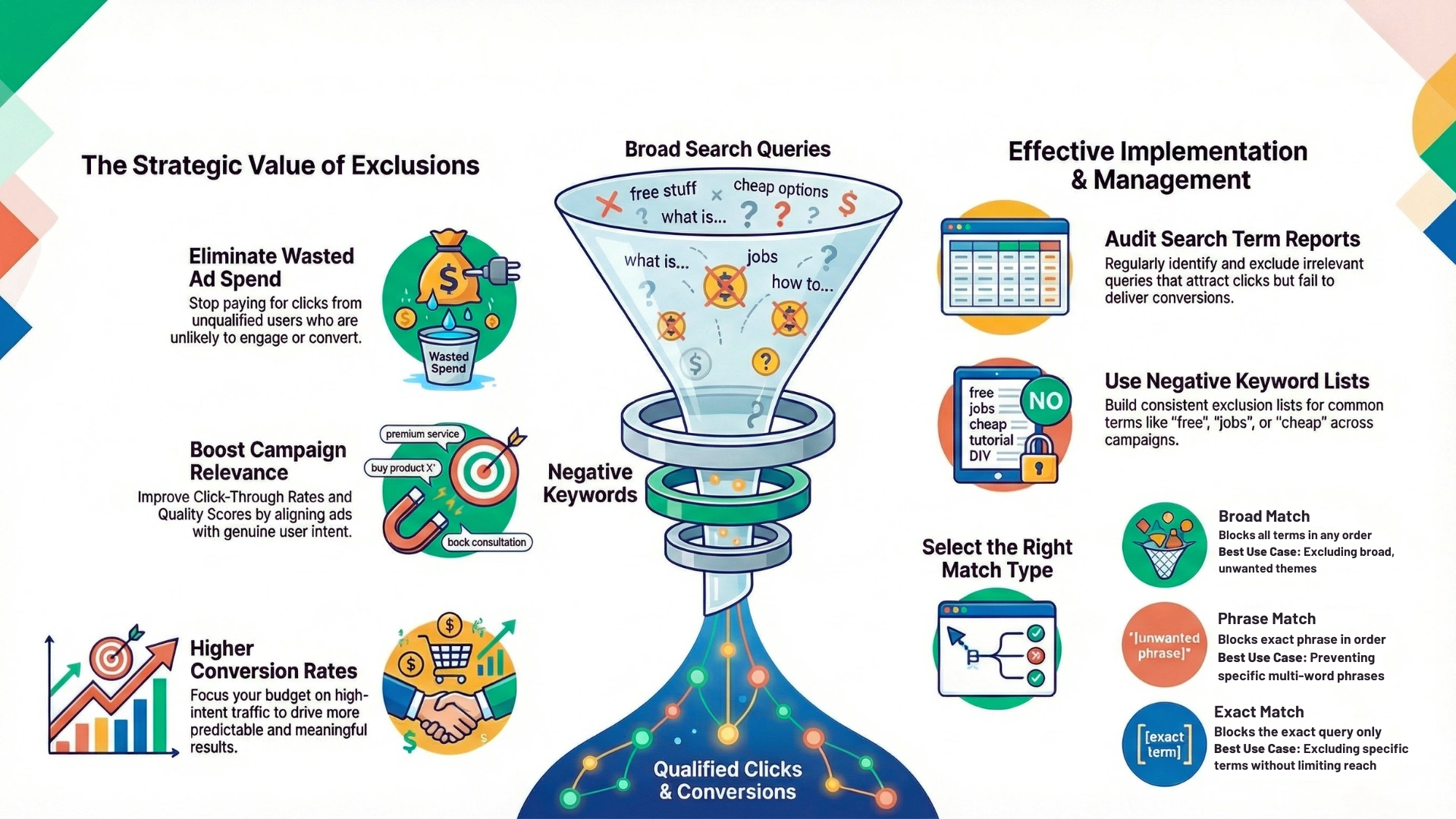
Negative keywords are terms that prevent your ads from appearing when a user’s search includes specific words or phrases. While regular keywords trigger ads, negative keywords act as filters to exclude unwanted searches.
For example, if you offer premium services and add “free” as a negative keyword, your ad will not appear for searches such as “free marketing tools”. This helps prevent clicks from users unlikely to convert.
Negative keywords can be applied at the ad group level, campaign level, or across the entire Google Ads account.
Why Do Negative Keywords Matter
Even with accurate keyword targeting, ads can still appear for loosely related or irrelevant searches due to broad matching. Negative keywords help refine this targeting. When used correctly, negative keywords align ads more closely with user intent, improving both efficiency and campaign performance.
They help advertisers:
- Prevent ads from showing to the wrong audience
- Improve click-through rates by filtering low-intent traffic
- Control rising ad costs caused by wasted clicks
- Ensure ads appear at the right moment for the right users
What Types of Negative Keyword Match Types Are Available?
Understanding negative keyword match types is essential for effective campaign control. Using the right match type allows advertisers to fine-tune how strictly ads are filtered.
Negative Broad Match Keywords
Blocks ads when a search contains all negative keyword terms, regardless of order. Useful for excluding broad themes.
Negative Phrase Match Keywords
Prevents ads from showing when a search contains the exact phrase in the same order. Offers more control than broad match.
Negative Exact Match Keywords
Blocks ads only when the search query exactly matches the negative keyword. Ideal for excluding very specific searches without limiting reach.
What Are the Benefits of Using Negative Keywords?
Negative keywords play a crucial role in improving campaign efficiency and profitability. By filtering out irrelevant or low-intent searches, businesses can focus their spend on users more likely to engage, convert, and deliver meaningful results.
When implemented correctly, negative keywords deliver clear performance benefits:
- Reduced wasted ad spend from unqualified clicks
- Improved Quality Score due to higher relevance
- Better control over where ads appear
- Higher conversion rates from intent-driven traffic
Over time, this leads to stronger returns and more predictable campaign results.
What Are Best Practices for Managing Negative Keywords?
Review Search Terms Regularly
The search term report is the most reliable way to identify irrelevant queries. Reviewing this data helps uncover keywords that attract clicks but do not convert.
Build and Maintain a Negative Keyword List
A structured list improves consistency and efficiency. Common exclusions include terms such as “jobs”, “cheap”, or “tutorial”, depending on business goals. Lists can be applied across multiple campaigns and updated as behaviour changes.
Segment Negatives by Campaign Intent
Not all campaigns require the same exclusions. Brand campaigns may allow broader searches, while conversion-focused campaigns benefit from stricter filtering. Applying negatives at the ad group level helps prevent keyword overlap and internal competition.
Refine Continuously Using Performance Data
Negative keyword management is ongoing. Conversion data, keyword research, and shifts in search behaviour should inform updates to ensure high-intent traffic is prioritised.
What Common Mistakes Should Be Avoided?
Even well-structured Google Ads campaigns can underperform if negative keywords are poorly managed. While they are designed to improve relevance and efficiency, incorrect implementation can unintentionally block valuable traffic or limit campaign reach. Below are common mistakes advertisers should avoid.
- Blocking high-intent traffic by overusing broad match negatives
Using broad match negative keywords too aggressively can block relevant variations of valuable searches, preventing ads from appearing for users who are genuinely ready to enquire, purchase, or convert. - Removing long-tail searches that may convert well
Some long-tail queries may seem irrelevant due to low volume, but they often signal strong intent. Excluding them too early can limit conversion opportunities and reduce overall campaign growth. - Applying negatives at the wrong level within the account
Adding negative keywords at the account level without proper review can unintentionally affect all campaigns, including brand or high-performing campaigns that rely on broader keyword coverage. - Failing to review and update negative keywords regularly
Search behaviour changes over time due to trends, seasonality, or new offerings. Without regular reviews, outdated negative keywords may restrict reach and gradually weaken campaign performance.
Conclusion: Strengthening Google Ads Campaigns Performance
The importance of negative keywords in Google Ads cannot be overstated. By filtering out irrelevant searches, businesses gain better control over ad spend, improve targeting accuracy, and reach users with genuine intent. However, managing negative keywords effectively requires ongoing analysis and a deep understanding of search behaviour.
At Aii Develop, we help businesses refine their Google Ads campaigns through structured keyword analysis, ongoing optimisation, and data-driven performance tracking. Our approach ensures negative keywords are used strategically; not just to reduce waste, but to improve conversions and long-term ROI.
If you want your campaigns to perform more efficiently and drive better results, speak with Aii Develop to review your current setup and uncover opportunities for improvement.