A well-structured Google Ads campaign can be one of the most effective tools in an education sector digital marketing strategy. However, without careful optimisation, it is easy to overspend on clicks that do not lead to enquiries or enrolment.
In an increasingly competitive education industry, reducing wasted ad spend is essential. Every click should contribute toward attracting prospective students, improving conversion rates, and maximising return on advertising investment.
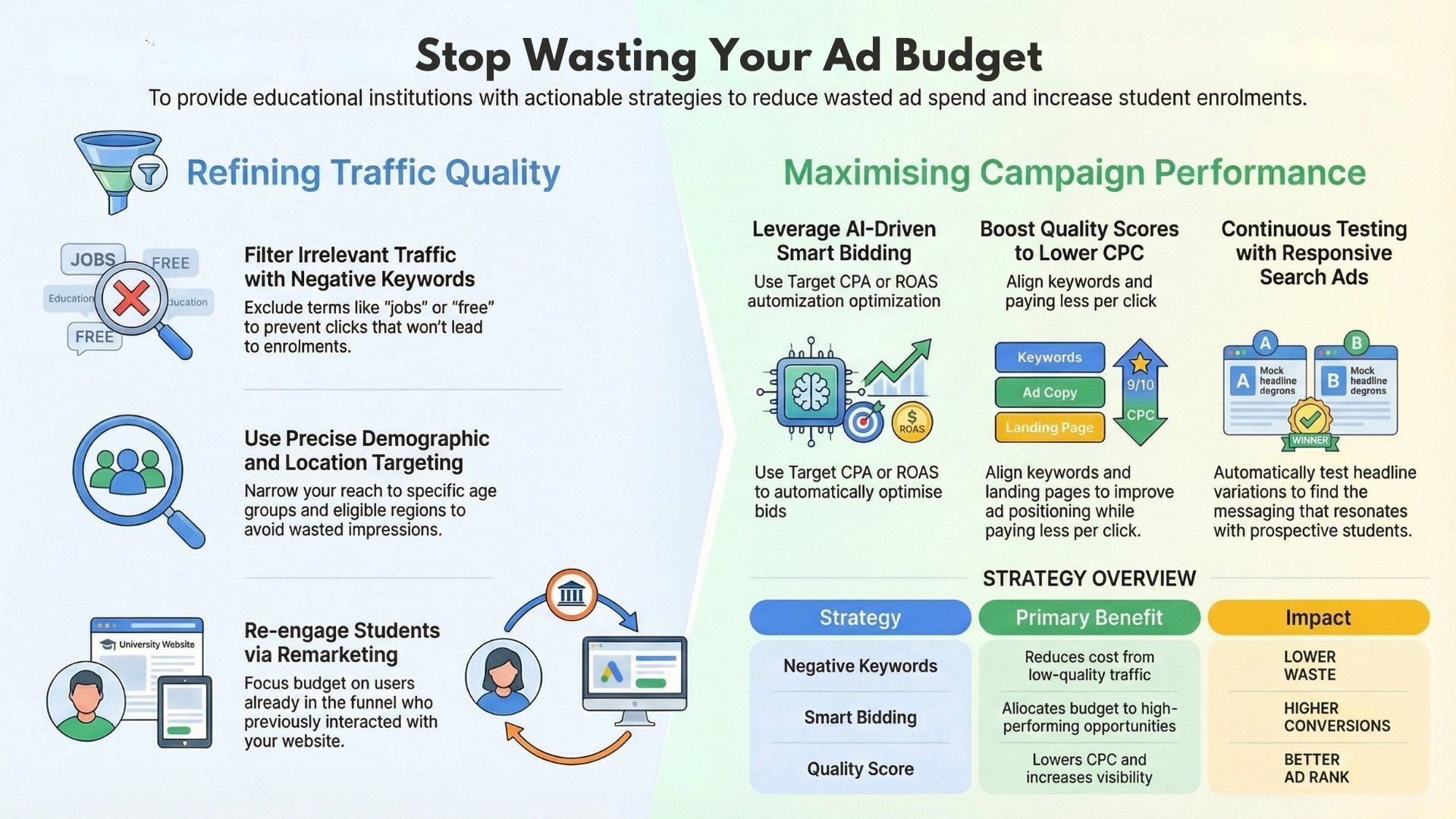
How Can Negative Keywords Prevent Wasted Ad Spend?
Using Negative Keywords to Filter Irrelevant Traffic
One of the most effective ways to reduce wasted advertising spend is by using negative keywords. These keywords prevent ads from appearing in irrelevant search queries that are unlikely to convert.
For example, if the campaign focuses on student recruitment, search terms such as “free courses” or “jobs at university” can lead to unnecessary clicks and wasted advertising budget.
Adding negative keywords at the campaign level helps:
- Prevent ads from appearing for irrelevant searches
- Reduce cost-per-click (CPC) from low-quality traffic
- Improve overall campaign efficiency
- Ensure ad spend targets prospective students actively searching
Auditing Search Terms to Reduce Waste
Regularly reviewing the search terms report within a Google Ads account provides valuable insight into actual user behaviour.
This allows institutions to:
- Identify wasteful or irrelevant search terms
- Add new exclusions to prevent unnecessary spend
- Refine keyword targeting based on performance data
- Improve conversion-focused traffic quality
Consistent monitoring ensures that the advertising budget is directed toward high-intent searches rather than wasted clicks.
How Do Bidding Strategies Help Optimise Campaign Performance?
Leveraging Smart Bidding for Better Results
Manual bidding can provide control, but it often leads to inefficiencies without continuous monitoring. Google Ads offers smart bidding strategies that use machine learning to optimise bids based on the likelihood of conversion.
Common strategies include:
- Target CPA (Cost Per Acquisition) to control the cost per conversion
- Target ROAS (Return on Ad Spend) to maximise revenue efficiency
- Automated bid adjustments based on performance data
Smart bidding helps reduce wasted ad spend by allocating budget more efficiently across high-performing opportunities.
Improving Quality Scores to Lower Cost-Per-Click
Quality Score plays a critical role in determining both cost-per-click (CPC) and ad positioning on the search engine results page.
Higher quality scores can be achieved by:
- Ensuring strong alignment between keywords, ad copy, and landing pages
- Creating relevant and compelling ad headlines and ad content
- Delivering a seamless landing page experience
Improved quality scores lead to:
- Lower CPC
- Higher click-through rates (CTR)
- Better visibility in search results
How Can Ad Content Optimisation Improve Conversion Rates?
Testing Multiple Ad Variations
Relying on a single version of an ad campaign can limit performance. Testing different variations of ad copy and ad headlines helps identify which messages resonate most with prospective students.
Using responsive search ads, Google automatically tests combinations of multiple headlines and descriptions to determine the most effective version.
Key testing areas include:
- Unique selling points (e.g. scholarships, career-focused programmes)
- Messaging tone and value propositions
- Calls-to-action that drive inquiries or applications
This continuous testing approach helps improve conversion rates and reduce wasted spend on underperforming ads.
Implementing Conversion Tracking for Data-Driven Decisions
Effective optimisation relies on accurate data. Conversion tracking within a Google Ads account, supported by tools like Google Analytics, enables institutions to measure campaign performance across every touchpoint.
Tracking allows institutions to:
- Identify which keywords drive conversions
- Measure the performance of landing pages
- Analyse user behaviour across the student journey
- Optimise campaigns based on real performance data
With clear insights, the advertising budget can be reallocated to campaigns that deliver stronger results.
Is Audience Targeting Crucial to Reducing Waste?
Refining Demographics and Location Targeting
Precise audience segmentation is essential to avoid wasted ad spend. Without proper targeting, ads may reach users who are unlikely to enrol.
Effective targeting includes:
- Narrowing demographics based on relevant age groups
- Applying location targeting to focus on eligible regions
- Aligning campaigns with specific programme offerings
This ensures ads reach the most relevant prospective students, improving both efficiency and conversion potential.
Using Performance Max and Remarketing Strategically
Performance Max campaigns allow institutions to reach users across multiple Google platforms using automated optimisation. When combined with remarketing, campaigns can re-engage users who have previously interacted with the institution’s website.
This approach helps:
- Increase conversions from high-intent audiences
- Reinforce messaging across multiple touchpoints
- Reduce wasted spend on low-intent traffic
- Strengthen overall campaign performance
Remarketing ensures that the advertising budget focuses on users already within the enrolment funnel, making it a cost-efficient strategy.
Is Your Google Ads Campaign Wasting Budget?
Managing a Google Ads campaign in the education sector requires continuous optimisation, strategic planning, and detailed performance analysis. From refining ad groups and improving quality scores to implementing smart bidding and audience targeting, every element plays a role in reducing wasted spend.
Aii Develop supports education institutions in building data-driven Google Ads strategies that improve campaign efficiency, reduce unnecessary ad spend, and maximise enrolment outcomes. Through continuous optimisation and performance insights, campaigns can be aligned more effectively with institutional goals.