Students and parents now rely on search engines, social platforms, and online research before choosing an institution. On the other hand, schools and institutions invest heavily in digital marketing but still struggle to generate strong enrolment results, qualified enquiries, or measurable return on investment.
In most cases, the problem is not a lack of effort, but common mistakes that weaken overall performance.
This post explores how a well-planned digital marketing strategy can help schools increase visibility, attract prospective students, and drive stronger engagement and conversions. It also highlights how consistent digital efforts can support long-term growth through improved search presence, content discovery, and stronger trust with prospective families.
Why Is Digital Marketing Important for Education Institutions?
Students and parents often compare schools across multiple touchpoints before making a decision. They may look up and search for programme details, tuition fees, graduate outcomes, reviews, campus facilities, and student life content before reaching out. To stay visible and competitive, educational institutions usually need several digital channels to work together, including:
- Search engine optimisation (SEO) for organic traffic
- Paid ads through search and social platforms
- Content marketing that answers questions
- Social media marketing (SMM) for engagement
- Data analytics for performance tracking
When these elements work together, institutions are better positioned to attract relevant enquiries and build trust with prospective students and parents. However, it is evident that many organisations still rely on outdated or fragmented marketing strategies.
What Are the Most Common Digital Marketing Mistakes in Education?
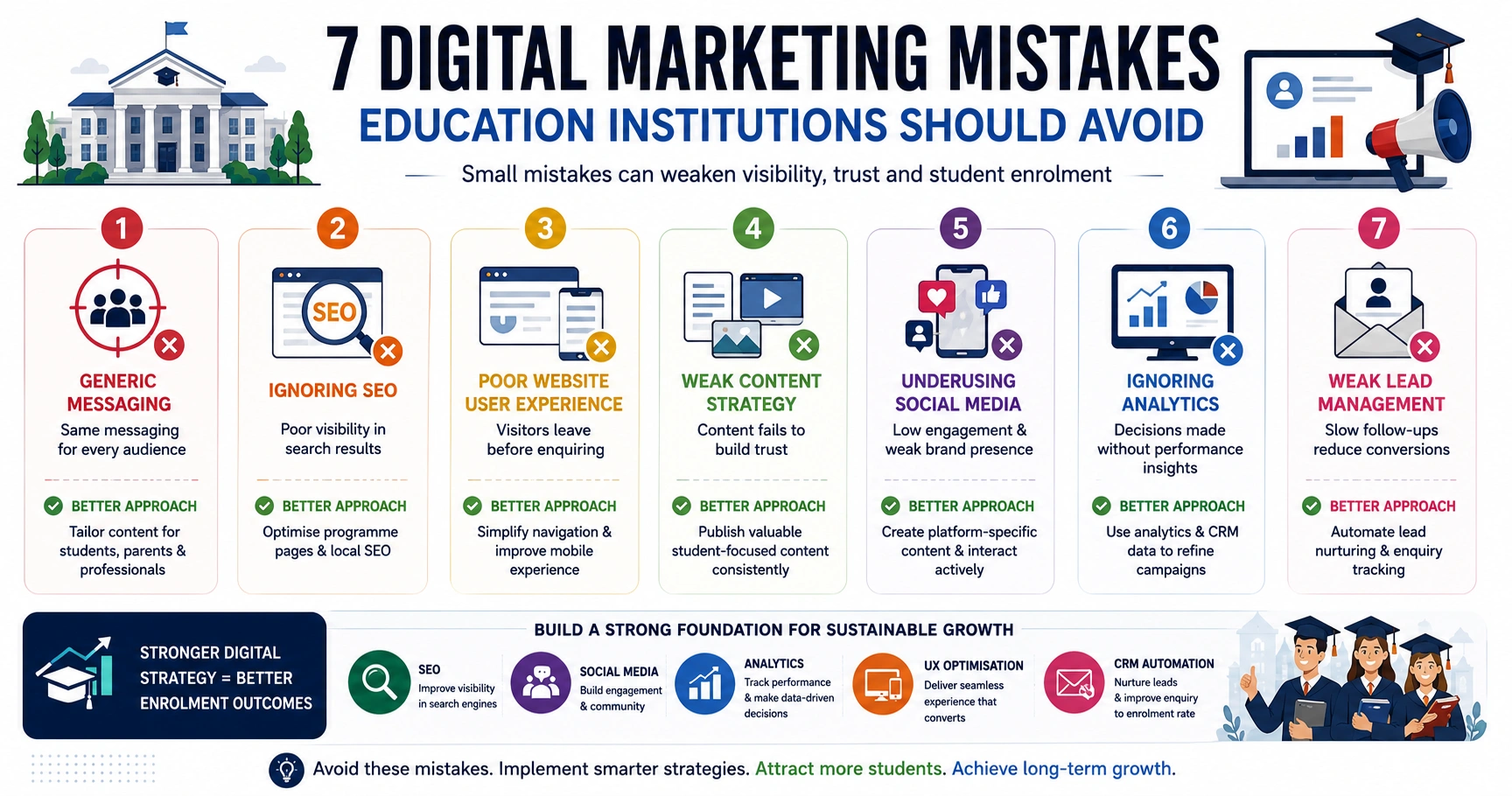
Adopting a “One-Size-Fits-All” Marketing Strategy
Most educational institutions still use the same messaging for all audience groups. However, different audiences often look for different things.
A local student may focus more on campus life and course options, while a working professional may focus on flexibility and career progression. International students may also look for support services, accommodation, and visa-related information.
Because of this, a one-size-fits-all approach can weaken engagement. Institutions are recommended to segment their audience and tailor their messaging based on what each group is actually looking for.
Examples include:
- Career-focused messaging for postgraduate programmes
- Campus culture and student life content for younger students
- Flexible learning and career progression messaging for working professionals
- Support-related content for international students
When the message feels more relevant, it becomes easier to build trust and encourage enquiries.
Ignoring Search Engine Optimisation (SEO)
Without any SEO effort, institutions struggle to appear in organic search results. Prospective students frequently search for information such as:
- Programme details
- Campus facilities
- Tuition fees
When a website content is not optimised for relevant keywords, an institution is likely to lose valuable traffic to their competitors.
Important SEO practices include:
- Keyword research for academic programmes
- Local SEO optimisation for campus searches
- Creating informative landing pages
- Optimising titles and meta descriptions
- Building shareable and engaging content
A strong SEO strategy improves ranking and supports long-term organic visibility.
Overlooking Website User Experience
Many education websites focus heavily on design but overlook usability. Having poor navigation can frustrate mobile users and discourage potential applicants. If students or parents cannot find key information (they are seeking), they may leave the site before taking the next step.
Common issues include:
- Complex site structure
- Slow loading pages
- Non-mobile-friendly layouts
- Confusing application journeys
Institutions should aim for intuitive navigation and simplified site architecture. Best practices include:
- Simplify navigation for key sections
- Create clear landing pages for each programme
- Optimise the website for mobile users
A user-friendly site improves engagement and conversion.
Weak or Inconsistent Content Marketing
Most schools publish content without a clear plan or do so too irregularly to make a lasting impact.
In education, content plays an important role in how students and parents evaluate an institution. They are not only looking for programme details, but also for a better sense of the learning experience, student outcomes, and overall credibility.
Useful content can include:
- Student testimonials
- Campus or virtual tour videos
- Alumni success stories
- Student life content
- Articles that answer common questions
When content is planned consistently and aligned with audience needs, it can improve visibility, build trust, and support enquiries over time.
Underusing Social Media Platforms
Social media plays an important role in how students discover and evaluate educational institutions. However, many schools still use it mainly for announcements or promotional updates.
A stronger strategy starts with understanding the role of each platform.
For example:
- TikTok works well for campus life and short-form discovery content
- Instagram is useful for student experience and visual storytelling
- LinkedIn is more suitable for executive education, professional courses, and graduate outcomes
Using the same type of content across every platform can limit engagement. Institutions should adapt content based on what users expect from each channel.
Social media should also be used as a two-way communication channel. Responding to comments and questions can help build trust and make the institution feel more approachable.
Not Using Data and Analytics Effectively
Some institutions run campaigns without reviewing performance data.
Without the right data, marketing teams cannot optimise their strategy effectively.
Key analytics tools include:
- Google Analytics
- CRM systems
- Campaign tracking dashboards
These tools reveal valuable insights into user behaviour, such as:
- Which pages attract organic traffic
- How visitors navigate the site
- Which campaigns drive lead generation
- Where drop-offs occur in the application process
Using data-driven insights allows marketers to refine campaigns and improve conversion rates.
Overlook on Lead Management and CRM Systems
Generating leads is only the first step. However, without proper systems, institutions may struggle to guide prospective students into their enrolment journey.
Modern education marketing adopts CRM platforms and automation tools to:
- Track enquiries
- Manage follow-ups
- Personalise communications
- Handle routine tasks
Automation helps marketing teams focus on strategy while improving response speed to potential applicants. This structured approach supports stronger lead generation and improved enrolment outcomes.
Conclusion
For education institutions, digital marketing is no longer just about having a website or posting on social media. It plays a major role in how students and parents research options, compare schools, and decide who to contact.
Avoiding common mistakes can make a real difference. When institutions improve their targeting, create more relevant content, strengthen website experience, and use digital channels more effectively, they are more likely to attract the right audience and turn interest into enquiries.
If your institution is reviewing its current digital marketing efforts, Aii Develop can help assess what is working, identify areas for improvement, and recommend the right strategy for your goals.
Reach out to Aii Develop to find out how your institution can build a stronger digital presence and improve student acquisition outcomes.
FAQ About Digital Marketing for Education Institutions
Schools or institutions should track performance using data analytics and reliable analytics tools. These insights reveal how prospective students interact with marketing campaigns.
Tools such as Google Analytics, CRM systems, and campaign dashboards help marketing teams analyse user behaviour and refine their strategy over time.
Personalisation allows institutions to communicate more relevant messages to different audiences. Prospective students may have different interests depending on their goals, location, or stage in the application journey.
For example, international prospects may look for visa support information, parents may prioritise graduate outcomes, and working professionals may focus on flexible learning options.
By tailoring content and messaging, institutions can create marketing experiences that resonate more strongly with students and parents.
Yes. Eligible education institutions and training providers in Singapore may apply for the Productivity Solutions Grant (PSG) to support digital marketing initiatives.
The grant can subsidise a significant portion of the implementation cost when working with pre-approved vendors.
For institutions looking to strengthen their digital presence, this support can help reduce the financial barrier to adopting effective digital marketing strategies.
For more information on eligibility and application guidance, institutions can contact Aii Develop.