As Google Ads continues to evolve, many businesses are finding it harder to maintain consistent performance.
Costs are rising, and Google’s AI now plays a bigger role in how campaigns are optimised. As a result, many businesses are unsure what actually drives Google Ads performance today.
To navigate this shift, businesses need to rethink how their campaigns are structured and how they work with Google’s AI.
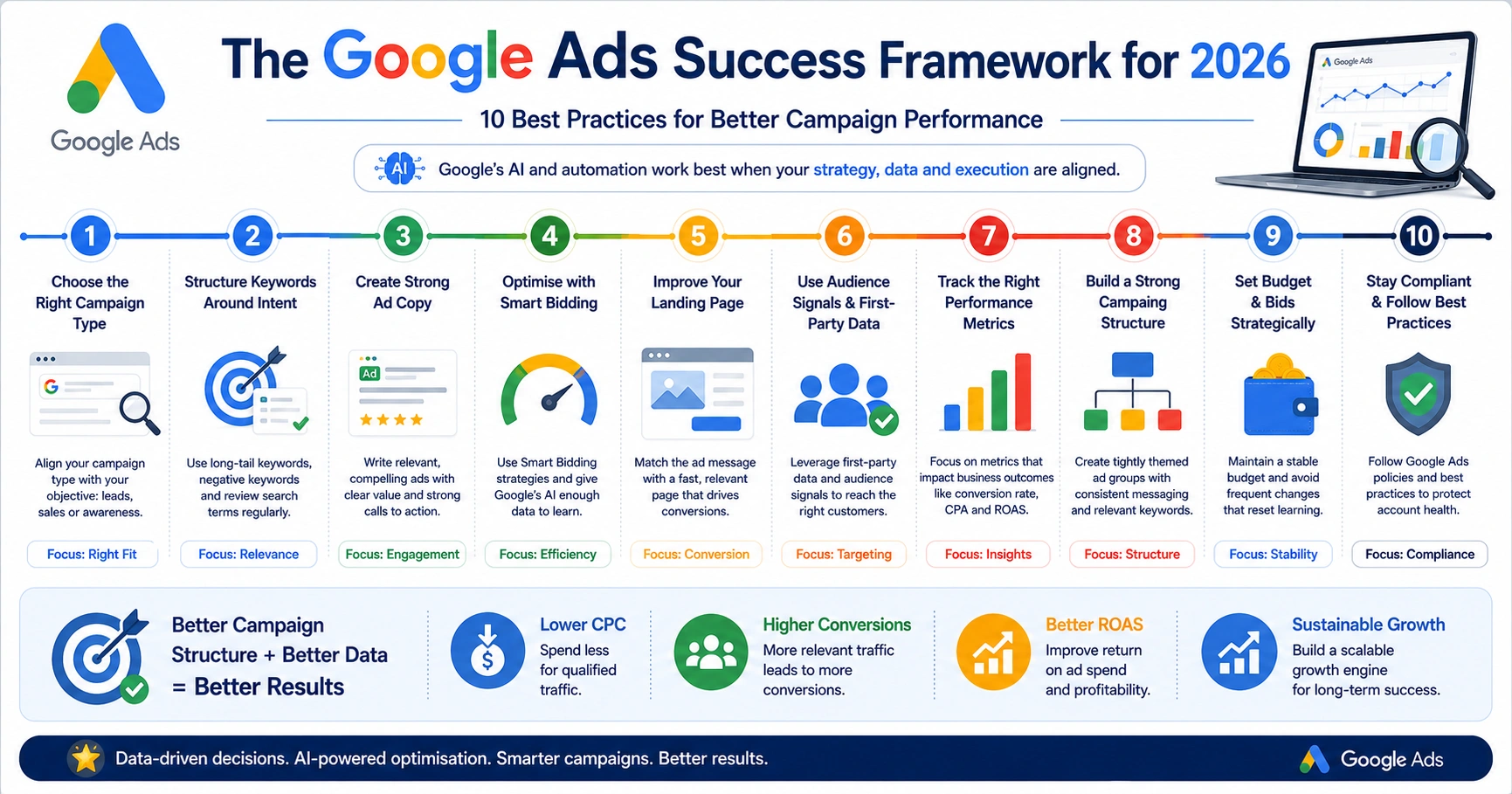
Are You Building Your Google Ads Campaign Around Google’s AI and Automation?
Modern Google Ads automation is designed to optimise campaigns in real time.
From automated bidding to targeting, Google continuously adjusts bids, placements, and audience signals to improve outcomes. This is especially evident in Performance Max campaigns, where a single campaign can reach users across Search, Display, YouTube, and other Google channels.
However, these systems rely heavily on data quality. Without accurate conversion tracking, automation lacks the signals needed to make effective decisions.
Best practice: Build your Google Ads campaign around strong data inputs and clear signals, then allow Google’s AI to optimise performance at scale.
Are You Choosing the Right Campaign Type to Optimise Google Ads Performance?
Once your campaign is aligned with Google’s AI, the next step is choosing the right campaign type.
Each format plays a different role. Search campaigns capture high-intent users based on specific search terms, while display ads help expand reach. Performance Max works by combining multiple ad formats into a single campaign.
Selecting the wrong campaign type can limit performance, regardless of budget or setup.
Best practice: Align your campaign type with your objective, whether it is to drive conversions, generate leads, or increase visibility.
Are Your Keywords Structured Around User Intent and Search Terms?
After defining your campaign type, your keyword structure determines how effectively you capture demand.
Google no longer relies solely on match types. Instead, it evaluates user intent, context, and behaviour behind each search query.
As a result, it is important to:
- Use long-tail keywords to capture high-intent users
- Apply negative keywords to filter irrelevant traffic
- Continuously review search terms to refine targeting
Best practice: Structure keywords around intent, not volume, and refine regularly to maintain relevance.
Is Your Ad Copy Strong Enough to Improve Ad Strength and Drive Clicks?
With the right keywords in place, your ad copy becomes a key factor in whether users click.
Google evaluates ad strength based on how well your messaging aligns with the keyword and user intent. Using responsive search ads, you can test multiple headlines and descriptions to improve engagement.
Even small differences in messaging can significantly impact performance.
Best practice: Align your ad copy closely with search intent and ensure your value proposition is clear, relevant, and action-driven.
Are Your Bid Strategies and Smart Bidding Aligned With Your Conversion Goals?
Once users engage with your ads, your bid strategy determines how efficiently you convert that traffic.
Smart Bidding relies on stable data and sufficient learning time to perform effectively. When set up correctly, it uses real-time signals to optimise for outcomes such as:
- Maximise conversions
- Target CPA
- ROAS
Best practice: Choose bidding strategies based on your business goals and avoid frequent changes that disrupt optimisation.
Is Your Landing Page Optimised to Convert Google Ads Traffic?
Clicks alone do not deliver results. Your landing page determines whether traffic converts.
A disconnect between your ad and landing page reduces trust and lowers conversion rates. This can include mismatched messaging, poor user experience, or unclear calls to action.
Best practice: Ensure your landing page reflects the keyword, matches the ad copy, and guides users clearly towards conversion.
Are You Using First-Party Data and Audience Signals to Reach the Right Customers?
As campaigns generate data, the next step is using it effectively.
With increasing privacy restrictions, first-party data and audience signals play a critical role in helping Google identify users interested in your products and services.
This allows campaigns to:
- Reach the right people
- Identify high-value users
- Expand to new customer segments
Best practice: Continuously feed your Google Ads account with accurate customer data to strengthen targeting and improve campaign performance.
Are You Tracking the Right Metrics to Improve Google Ads Performance?
To refine campaign performance, measurement must go beyond clicks.
Surface-level metrics do not reflect true outcomes. Instead, focus on metrics that directly impact business results, such as:
- Conversion rate
- Cost per acquisition (CPA)
- Return on ad spend (ROAS)
Best practice: Focus on outcomes that directly impact revenue and use these insights to guide ongoing optimisation.
Is Your Campaign Structure and Ad Group Setup Too Broad to Be Effective?
As more data becomes available, your campaign structure must evolve.
Broad or poorly organised ad groups often contain mixed keywords and inconsistent messaging, which reduces relevance and increases CPC.
A tighter structure improves alignment between the keyword, ad copy, and landing page.
Best practice: Keep each ad group focused on a specific theme or intent to improve efficiency and overall performance.
Are You Setting Your Budget and Bids Strategically to Optimise Campaign Performance?
With a strong structure in place, budget decisions should support long-term optimisation.
Frequent changes to budgets or bids can reset learning and limit the effectiveness of automation.
Best practice: Set a stable daily budget aligned with your goals, and adjust based on performance trends rather than short-term fluctuations.
Is Your Google Ads Account Compliant With Advertising Policies and Best Practices?
Finally, even well-optimised campaigns can be disrupted by compliance issues.
Google enforces strict guidelines across ad content, claims, and data usage. Violations can result in ads being disapproved or delivery being restricted. In more serious cases, repeated violations may trigger Google’s Three-Strike Policy, where accounts can face escalating penalties, including temporary suspension.
Best practice: Ensure your Google Ads account follows all policies and aligns with Google Ads best practices to maintain consistent campaign performance.
Why These Google Ads Best Practices Matter
Competition in online advertising continues to intensify, and running a high-performing Google Ads campaign is no longer just about setup or budget.
Businesses that succeed today are those that:
- Align with Google Ads automation
- Use data-driven campaign optimisation
- Continuously refine their strategy based on performance
Because today, success is not just about visibility, it’s about efficiency, scalability, and measurable results.
Looking to Improve Your Google Ads Campaign Performance?
Improving Google Ads performance takes more than just launching campaigns. It requires the right strategy, continuous optimisation, and a clear understanding of how Google’s AI drives results.
If you’re looking to optimise your Google Ads campaign and achieve more consistent, measurable outcomes, our team at Aii Develop is here to help.
Speak to us today and build a smarter, high-performing advertising strategy for 2026.