Many businesses hire an SEM agency in Singapore, hoping to see quick results. And while search ads can start driving traffic soon after launch, strong and consistent performance usually takes more than a few days.
The first three months are not just about getting leads or conversions. They are also the stage where campaigns are set up properly, early data starts coming in, and meaningful optimisation begins.
Understanding what to expect from an SEM agency during this period can help businesses set more realistic goals, assess performance more fairly, and build a stronger foundation for long-term growth.
Can Search Engine Marketing Agency Deliver Results?
SEM (search engine marketing) can generate visibility quickly. Once a campaign goes live, ads may start appearing on Google within days, which can lead to early clicks, website visits, and enquiries.
However, a sudden boost in traffic does not always mean efficient performance right away. In the early stage, campaigns are still learning. Keyword targeting, bidding strategy, search intent, and landing page effectiveness all need time to be tested and improved.
That is why businesses should work with an agency that sets clear expectations from the start. The first few weeks are usually less about instant wins and more about learning what works, what does not, and where the campaign can improve.
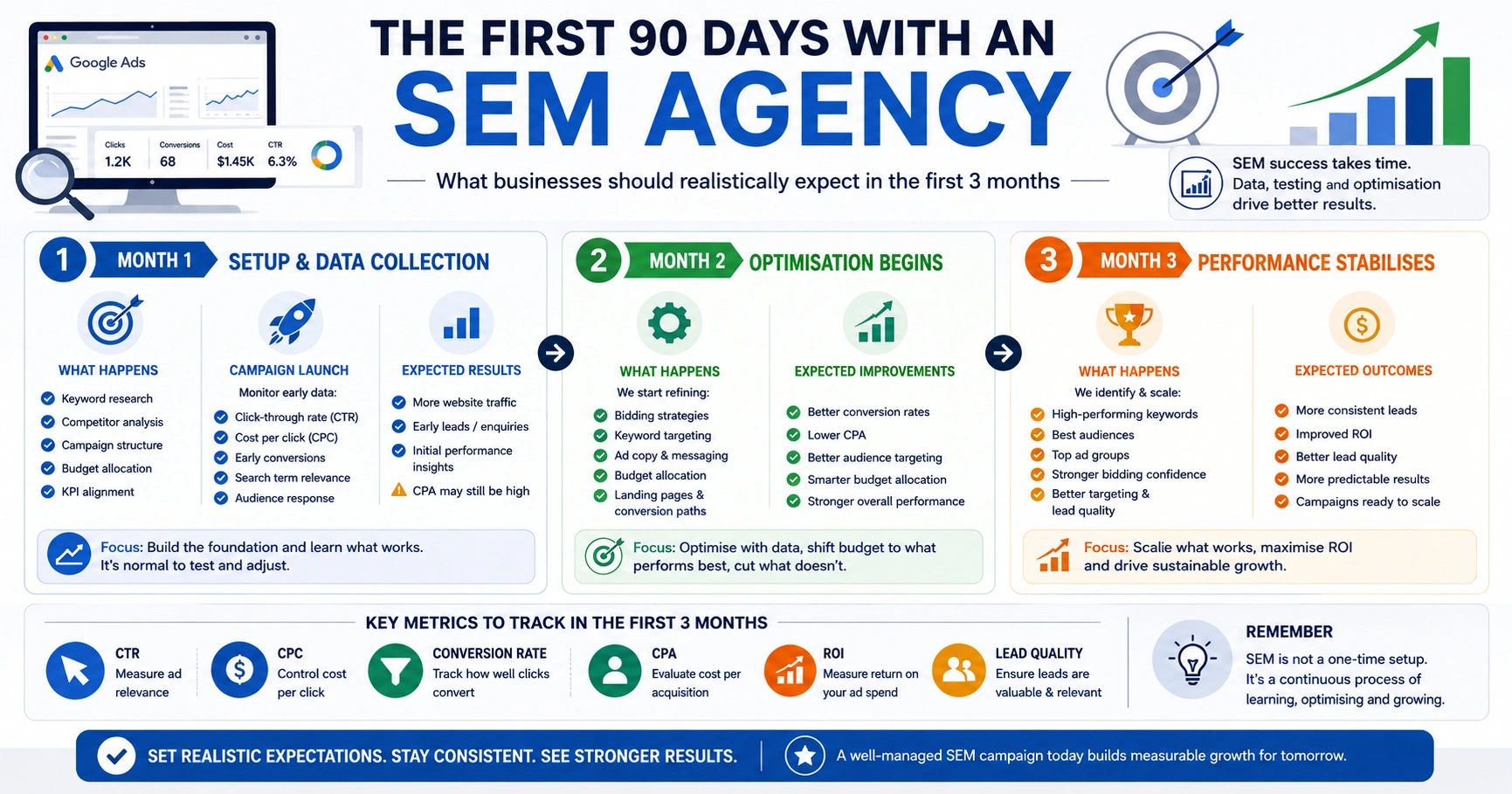
What Happens During the First Month of an SEM Campaign?
Strategy Development, Keyword Research and Campaign Structuring
The first month is usually focused on setting up the campaign properly. A well-developed onboarding process matters because a weak setup can lead to wasted ad spend, poor targeting, and weaker performance later on.
This stage often includes keyword research based on search intent, competitor review, campaign structure planning, landing page checks, monthly budget allocation and KPI alignment. All of this helps make sure the campaign is built around the business goals, target audience, and available budget.
Campaign Go-Live and Initial Data Collection
Once the campaign goes live, ads begin appearing in search results, and early data starts to come in. At this stage, the agency will usually monitor early indicators such as:
- Click-through rate (CTR)
- Cost per click (CPC)
- Early conversions
- Search term relevance
- Audience response
It is normal for performance to fluctuate during this phase. The campaign is still gathering data, and adjustments are often being made as Google’s learning period continues.
What Results Are Realistic in Month One?
In the first month, businesses can usually expect more website traffic, early leads or enquiries, and a clearer view of how keywords and ads are performing. That said, cost per acquisition (CPA) may still be high at this stage. This is common because the campaign is still collecting data and has not yet reached its most efficient level.
What Improves in the Second Month?
Data-Driven Optimisation Begins
By the second month, the campaign usually has sufficient historical data for an agency to make informed decisions. At this stage, the agency may start refining and benchmarking:
- Bidding strategies
- Keyword targeting
- Ad copy and messaging
- Budget allocation
- Landing pages and conversion paths
This is where the campaign often starts becoming more efficient, with clarity, as decisions are based less on assumptions and more on actual performance data.
When Does Budget Allocation Become More Efficient?
As the agency gathers insight on which keywords, audiences, and ad groups are performing best, the budget can be shifted more confidently towards what is working.
This often leads to:
- Better conversion rates
- Improved cost efficiency
- Stronger overall performance
- Closer alignment with business goals
At the same time, underperforming search terms or ad groups can be paused, adjusted, or removed.
What are the Realistic Expected Results in Month Two?
By month two, businesses often start to see better conversion rates, momentum building towards lower CPA compared to month one, and a stronger match between the ads and the intended audience. Performance is usually moving in the right direction by this stage, but it still benefits from active monitoring and regular refinement.
What Should Businesses Expect by the Third Month?
Campaign Performance Starts to Stabilise
By the third month, campaigns often begin to stabilise. With increased data available, campaign adjustments become more informed, and tools like automation or smart bidding may start working more effectively.
At this point, the agency should be able to establish a clear view of what is performing well. High-performing keywords become easier to identify, bidding can be refined with more confidence, and stronger ad groups can be scaled more effectively. It is also easier to improve targeting and increase lead quality at this stage.
Can SEM Deliver Measurable ROI in the First 3 Months?
By the end of the first few months, a well-managed SEM campaign should start showing clear picture and project for a predictable measurable outcomes. These may include:
- Lower CPA
- Higher conversion rates
- More consistent lead generation
- Better alignment between ad spend and return on investment
For some businesses, SEM may begin contributing more directly to revenue during this period. However, results still depend on factors such as industry competition, budget, offer strength, and landing page quality.
Why Do SEM Campaigns Take Time to Optimise?
Google Needs Time to Learn
Google’s advertising system relies on data. Without enough data, it becomes harder to optimise an SEM campaign effectively.
That is why the early stage is often used to:
- Test keyword performance
- Adjust bidding strategies
- Evaluate search intent
- Improve the user journey on landing pages
This learning period is necessary. It helps the campaign become more efficient over time and gives the agency a better understanding of what is driving results.
Do Industry and Sales Cycles Affect Results?
Yes, they do. Different industries have different levels of competition, customer behaviour, and sales cycle length.
For example:
- B2C businesses may see results faster
- B2B services often take longer because decision-making is more complex
- Newer businesses may need more time to test their messaging, offers, or positioning
Because of this, the timeline for seeing measurable SEM results can vary from one business to another.
What Metrics Should Be Evaluated in the First 3 Months?
Businesses should track both early indicators and longer-term performance signals when reviewing campaign progress.
Important metrics include:
- Click-through rate (CTR)
- Cost per click (CPC)
- Conversion rate
- Cost per acquisition (CPA)
- Return on investment (ROI)
- Lead quality and conversion intent
These metrics help show whether the campaign is improving over time and whether the strategy is aligned with the objective.
What Are Red Flags When Working with an SEM Agency?
Not all agencies follow the same standards or level of transparency. That is why businesses should also know what warning signs to watch for.
Common red flags include:
- Promising immediate or guaranteed results
- Unclear reporting
- No clear strategy or roadmap
- Poor alignment with goals
- Little explanation of what is being optimised and why
A reliable SEM agency in Singapore should provide clear communication, transparent reporting, strategic direction, and ongoing optimisation backed by real performance data.
Conclusion: Is the SEM Strategy Built for Long-Term Success?
SEM can generate visibility and traffic quickly, but stronger business results usually come from consistent refinement over time. The first three months are important because they help shape the campaign, improve cost efficiency, and reveal what is actually driving performance.
During this period, a good SEM agency should do more than just launch ads. It should provide clear planning, regular reporting, and ongoing improvements based on real campaign data.
For businesses in Singapore, this makes it easier to judge whether the campaign is moving in the right direction and whether the strategy supports long-term growth.
If you are looking for a transparent and data-driven SEM agency in Singapore, Aii Develop can help you build a search strategy focused on measurable growth and sustainable results.