A well-executed SEM campaign is a key driver of traffic and conversions in today’s competitive digital landscape. Many businesses invest in SEM services in Singapore to improve visibility across search engines like Google, but not all campaigns deliver consistent results.
A common challenge is increasing ad spend without seeing an increase in the conversion rate. This often occurs when campaigns are launched without ongoing optimisation or data-driven refinement.
A/B testing, also known as split testing, plays a critical role in improving ad performance. By testing different elements and analysing user behaviour, businesses can make informed marketing decisions that improve efficiency and maximise return on investment (ROI).
When applied effectively, A/B testing helps:
- Improve conversion
- Lower cost per acquisition (CPA)
- Optimise overall ad spend
- Enhance campaign performance
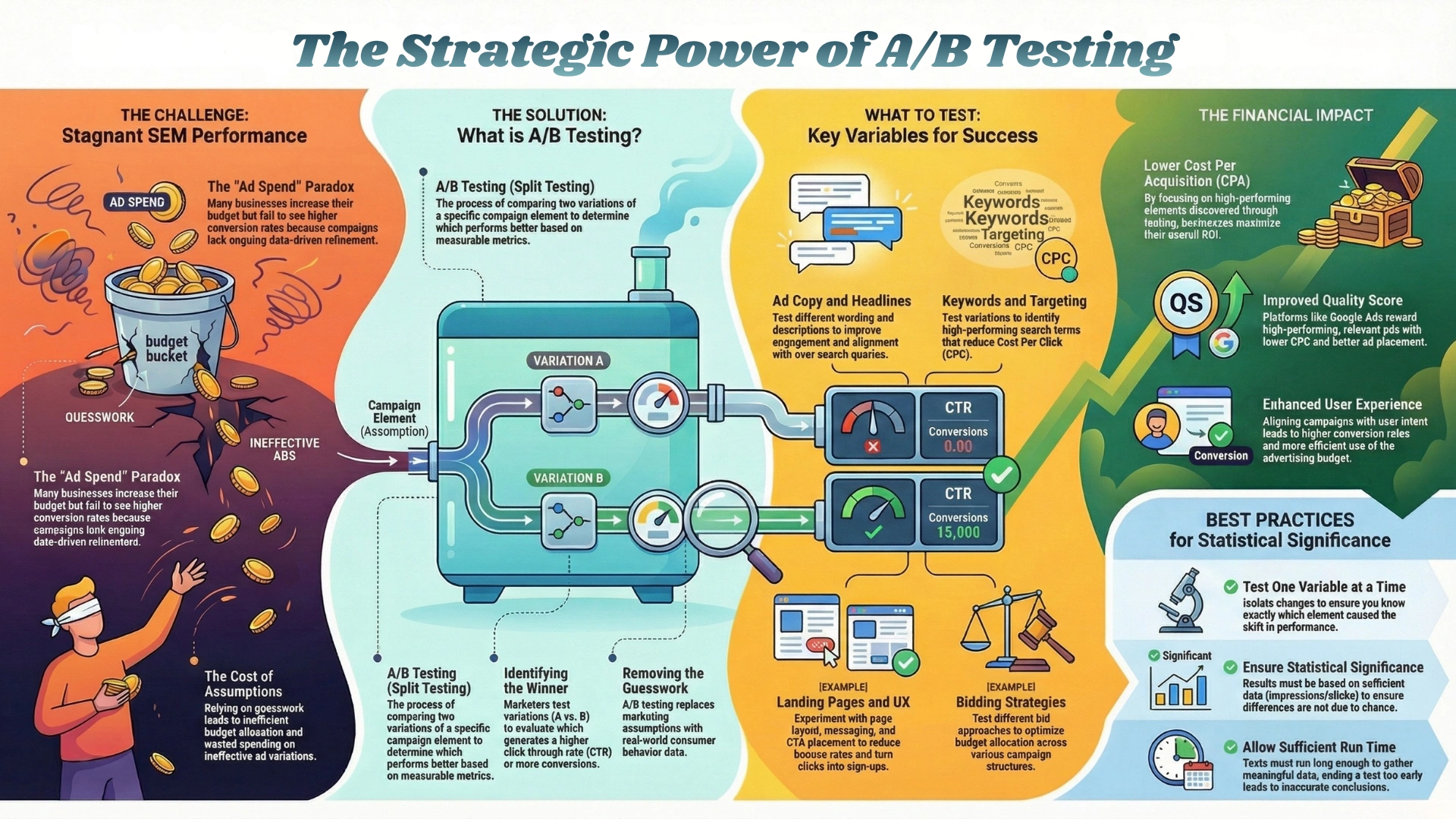
What Is A/B Testing in Search Engine Marketing?
A/B testing is the process of comparing two variations of a specific campaign element to determine which performs better based on measurable metrics.
In search engine marketing, this may include testing:
- Ad copy performance and variations
- Headlines and descriptions in Google Ads
- Landing page layouts and structure
- Call-to-action (CTA) placement and wording
For example, two versions of an ad headline may be tested to evaluate which generates a higher click-through rate (CTR) or leads to more conversions. The objective is to identify which variation yields stronger results and contributes to better outcomes across search engine results pages (SERPs).
Why Is A/B Testing Important for SEM Performance?
Does A/B Testing Reduce Wasted Ad Spend?
Without performing A/B testing, campaigns rely on assumptions, which can lead to wasted ad spend and inefficient budget allocation. A/B testing helps:
- Identify low-performing elements
- Eliminate wasteful spending on ineffective ads
- Refine targeting and messaging
- Improve budget efficiency
By continuously refining campaigns, businesses can reduce unnecessary spend and focus on strategies that deliver measurable results.
How Does A/B Testing Improve Conversion Rates?
Even small changes in messaging or design can significantly impact conversion rates.
A/B testing helps identify:
- Which headlines generate more clicks
- Which landing pages drive more sign-ups
- Which offers resonate with the target audience
This leads to improved engagement, stronger user experience, and higher conversions.
Why Is Data-Driven Optimisation Important?
A/B testing removes guesswork from digital marketing.
Instead of relying on assumptions, decisions are guided by performance data, allowing businesses to:
- Optimise campaigns based on real consumer behaviour
- Improve campaign goals alignment
- Increase overall ROI
Which Elements Should Be Tested in SEM Campaigns?
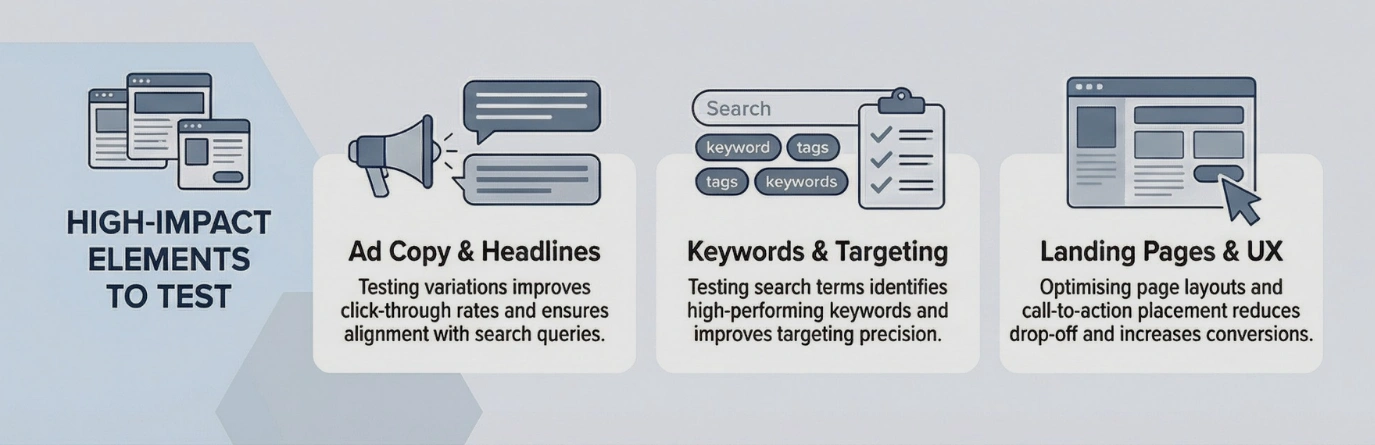
Ad Copy and Headlines
Ad content is often the first interaction users have with a brand. Testing different variations helps improve:
- Click-through rate (CTR)
- Engagement and relevance
- Alignment with search queries
Even small changes in wording can influence a person’s behaviour and campaign outcomes.
Keywords and Targeting
Keyword strategy is central to SEM success.
Testing different keyword variations helps:
- Identify high-performing search terms
- Improve targeting precision
- Reduce cost per click (CPC)
- Increase visibility in relevant search results
Landing Pages and User Experience
A well-optimised landing page is essential for turning clicks into conversions. In an SEM campaign, even small changes can affect how users respond and whether they take action.
Key elements worth testing include:
- Page layout and structure
- Headlines and messaging
- Call-to-action placement
These elements can influence the overall experience, reduce drop-off, and improve conversion.
Bidding Strategies and Budget Allocation
Different bid strategies can produce varying results.
Testing allows businesses to:
- Optimise budget allocation
- Improve ROI
- Reduce unnecessary ad spend
How Does A/B Testing Lower Ad Costs?
Identifying High-Performing Elements
A/B testing highlights which elements deliver the strongest results.
Focusing on these elements helps:
- Improve campaign efficiency
- Reduce cost per acquisition (CPA)
- Maximise overall ROI
Improving Quality Score in Google Ads
Platforms like Google Ads use the Quality Score to determine ad ranking and cost-per-click (CPC).
Higher-performing ads typically result in:
- Lower CPC
- Better ad placement
- Increased visibility on search engine results pages
A/B testing helps improve these metrics over time through continuous optimisation.
Enhancing User Experience
When campaigns align with user intent, engagement improves.
Better user experience leads to:
- Higher conversion rates
- Lower bounce rates
- More efficient use of advertising budget
What Makes an A/B Test Statistically Significant?
For A/B testing to deliver reliable insights, results must be statistically significant.
This means:
- Sufficient data has been collected
- Results are consistent and repeatable
- Differences are not due to chance
Key metrics to evaluate include:
- Number of impressions
- Number of clicks
- Conversion rate
Running tests for too short a period can lead to inaccurate conclusions. Adequate time is required to gather meaningful performance data.
How Long Should A/B Tests Run?
The duration of A/B testing depends on several factors, including:
- Campaign budget
- Traffic volume
- Industry competition
In most cases, tests should run long enough to generate sufficient data before making optimisation decisions.
Continuous testing is essential. Campaigns should evolve based on new insights and changing user behaviour.
What Are Best Practices for A/B Testing in SEM?
To maximise results, businesses should follow these best practices:
- Test one variable at a time to isolate the impact
- Define clear campaign goals and KPIs
- Ensure sufficient traffic for accurate analysis
- Track performance using tools like Google Analytics
- Continuously refine campaigns based on insights
Following these practices helps improve long-term SEM performance and campaign efficiency.
How Does A/B Testing Fit Into a Larger SEM Strategy?
A/B testing is not a standalone activity. It is part of a broader SEM strategy that includes:
- Keyword research and targeting
- Campaign structure optimisation
- Landing page optimisation
- Performance tracking and analytics
Within a comprehensive digital marketing strategy, A/B testing enables continuous improvement across all campaign elements. A data-driven approach ensures that campaigns remain aligned with business goals, improve over time, and deliver sustainable results.
Are You Maximising Your Campaign Performances?
A/B testing is essential for improving campaign outcomes and reducing wasted ad spend. It enables businesses to move beyond assumptions and make informed decisions based on real performance data.
In a competitive digital landscape such as Singapore’s, continuous optimisation is critical to maintaining efficiency and achieving long-term growth.
Aii Develop provides SEM services in Singapore focused on data-driven optimisation, helping businesses refine campaigns, reduce ad costs, and improve conversion outcomes through continuous testing and strategic execution.
FAQ on A/B Testing for SEM Campaign Performance
A/B testing is the process of comparing two versions of a campaign element to determine which performs better. It helps improve conversion rates and reduce ad costs.
By identifying high-performing elements, businesses can allocate budget more efficiently, leading to higher conversion rates and improved return on investment.
High-impact elements such as ad copy, headlines, and landing pages should be prioritised, as they directly influence engagement and conversions.
Results depend on traffic volume and campaign budget. Meaningful insights typically require sufficient data collected over time.
Yes. By improving ad relevance and performance, A/B testing can lead to better quality scores, which may reduce CPC.