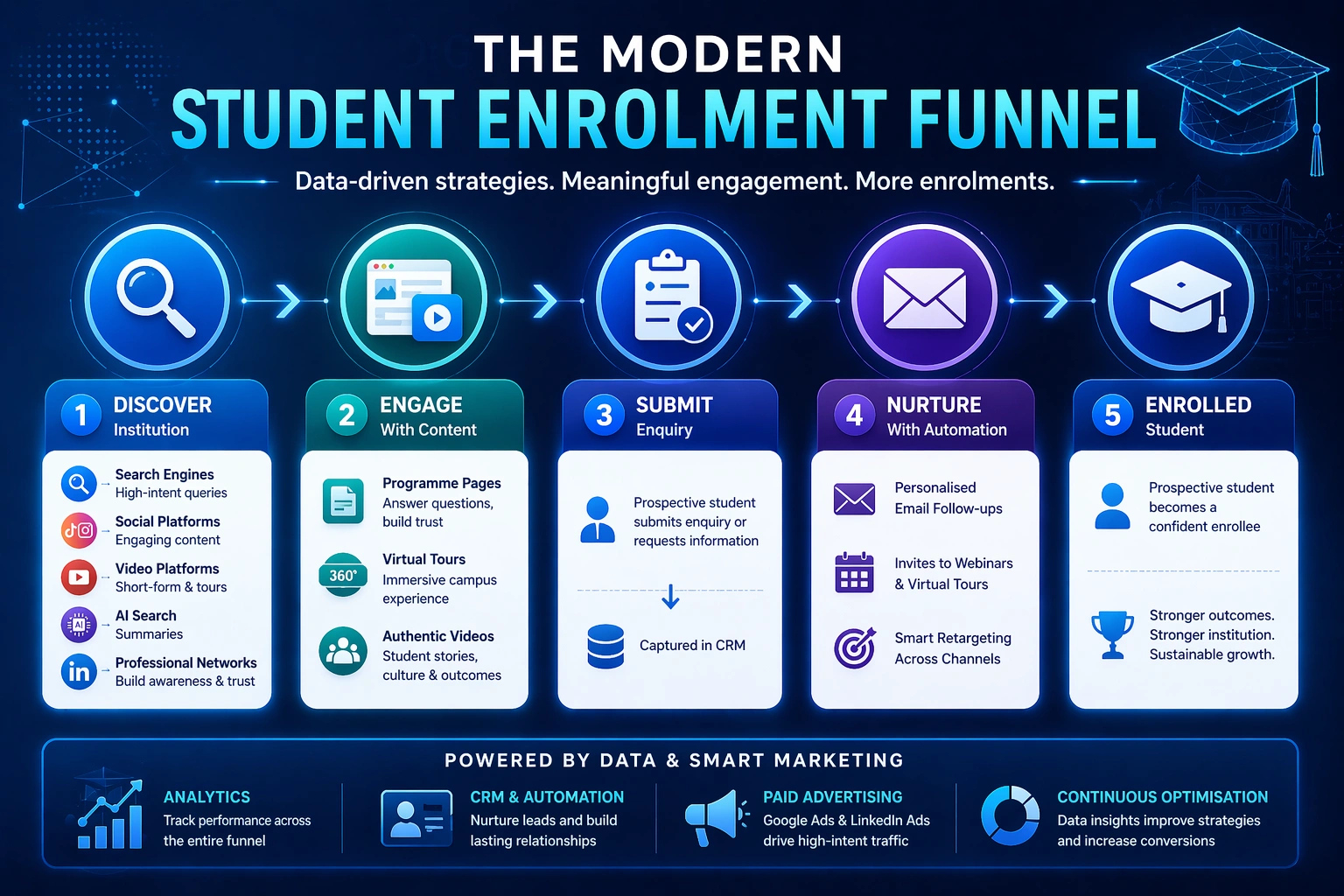
The student enrolment journey is no longer linear. Prospective students now discover institutions across multiple digital touchpoints, from search engines to social platforms and video content.
In this increasingly competitive landscape, institutions must adopt data-driven digital marketing strategies to improve visibility, connect with prospective learners, and drive stronger enrolment outcomes.
How Should Search Engine Optimisation Adapt to AI-Driven Search?
Ranking Higher in Search Results for Conversational Queries
Students increasingly use natural language when searching for learning opportunities. Instead of typing simple keywords, search queries now resemble full questions such as “best career-focused nursing programmes near me” or “online learning programmes available for working professionals.”
To appear higher in search results, institutions must ensure their programme pages and course pages are well-optimised to answer the questions prospective students are actively searching for.
Effective SEO strategies include:
- Structuring programme pages with clear headings and FAQ sections
- Addressing common questions prospective students ask
- Creating content that answers specific search queries
- Ensuring content is designed to capture organic traffic
Well-optimised content helps institutions appear more prominently in search results, increasing visibility and attracting prospective students actively researching learning programmes.
Optimising for “Search Everywhere” Visibility
Visibility is no longer limited to Google search results. Today’s students discover education options across multiple digital platforms.
A modern strategy should focus on Search Everywhere optimisation, ensuring information can be discovered across:
- Search engines
- Social platforms like TikTok and Instagram
- Video content platforms
- AI-powered search summaries
When prospective students encounter an institution through these channels, the exposure creates social proof and helps build trust during the early stages of the student journey.
Different content formats support various stages of the enrolment journey.
| Content Type | Strategic Focus | Goal |
|---|---|---|
| Program Pages | Answer-first structure with FAQs | Capture intent-based search queries |
| Short-Form Video | Authentic student-led content | Boost social engagement |
| Virtual Tour | Immersive, mobile-friendly experience | Increase engagement and conversion |
Why Does Video Content Make a Significant Impact on Recruitment and Education Marketing?
Using Short-Form Video to Connect with Prospective Students
Short-form video is increasingly how future students evaluate an institution’s culture and learning environment. Platforms like TikTok, Instagram Reels, and YouTube Shorts allow educational institutions to share authentic and engaging content that resonates with potential learners.
Unlike traditional advertising, student-generated video content feels more genuine and relatable. This authenticity helps build trust with prospective students and strengthens engagement across social platforms.
Short-form video can be used to showcase:
- Campus experiences
- Classroom activities
- Student testimonials
- Career-focused learning programmes
Showcasing the Student Journey Through Video Marketing Strategies
Video content also plays a powerful role in illustrating the student journey.
A well-developed content strategy may include:
- Virtual campus tours that allow prospective students to explore facilities online
- “Day-in-the-life” videos featuring current students
- Alumni success stories that highlight career outcomes
These storytelling formats create trust-building content and provide the social proof that prospective students often rely on when making enrolment decisions.
How Does Data-Driven Analytics Improve Enrolment Outcomes?
Measuring Performance with Google Analytics
A successful digital marketing strategy relies heavily on performance measurement.
Tools like Google Analytics allow institutions to track how organic traffic moves through the student funnel, from blog content to programme pages, landing pages, and eventually to inquiry forms or information requests.
Key metrics that institutions should monitor include:
- Website traffic sources
- Engagement with programme pages
- Landing page conversion rates
- Student inquiry and info request volumes
By analysing this data, institutions can identify which marketing strategies generate the strongest engagement and optimise campaigns accordingly.
Improving the Enrolment Funnel with CRM and Automation
Modern education marketing strategies also rely on a robust CRM system to nurture leads throughout the enrolment journey.
When prospective students submit an inquiry or request information, automated workflows can deliver tailored follow-ups such as:
- Personalised email communications
- Invitations to virtual tours or webinars
- Targeted advertising on platforms like LinkedIn
Each interaction should include a clear call-to-action that guides prospective students toward the next step in their enrolment decision.
This approach helps institutions maintain engagement with potential learners and improve conversion rates across multiple touchpoints.
How Can PPC Advertising Elevate Institutional Visibility?
Targeting High-Intent Search Queries with Google Ads
In competitive education markets, organic traffic alone may not always be sufficient to achieve visibility.
PPC advertising, particularly through Google Ads, allows institutions to appear at the top of search results for high-intent keywords related to specific learning programmes.
Paid advertising can support recruitment efforts by:
- Targeting prospective students actively searching for programmes
- Promoting career-focused courses or professional certifications
- Increasing visibility for newly launched programmes
While ads often generate the initial discovery, the overall digital marketing strategy must be designed to convert interest into inquiries and enrolments.
Leveraging LinkedIn for Continuing Education Recruitment
For institutions offering postgraduate, executive, or continuing education programmes, LinkedIn is a valuable recruitment platform.
LinkedIn advertising allows institutions to target professionals based on:
- Industry
- Job title
- Career experience
- Professional interests
This level of precision helps institutions connect with professionals seeking career advancement or specialised training.
Is Your Institution Optimised to Lead in the Digital Age?
Success in modern education marketing requires a strategic combination of search engine optimisation, engaging content, data-driven analytics, and targeted advertising.
Institutions that adopt structured digital marketing strategies are better positioned to connect with prospective students, nurture engagement across digital touchpoints, and improve enrolment outcomes.
Aii Develop supports education institutions in building data-driven digital marketing strategies designed to improve visibility, strengthen engagement with prospective learners, and convert inquiries into enrolments. Through strategic planning, optimisation, and performance insights, institutions can better navigate today’s competitive digital recruitment landscape.