The human brain is wired to remember unfinished tasks or loose ends. That’s why a half-watched product video, an abandoned cart, or a briefly browsed service page lingers in a user’s mind long after they’ve left your site. A quiet, unresolved thread in their mental narrative.
This isn’t just a quirk of attention; it’s a cognitive bias known as the Zeigarnik Effect. It’s one of the most powerful digital marketing strategies available, as people remember uncompleted tasks more vividly than completed ones.
For Singapore businesses operating in a market where nearly every buyer researches online before making a decision, but few ever convert on their first visit, retargeting isn’t just smart marketing. It’s essential. In this guide, you’ll learn how to turn psychological insight into real revenue by building high-converting retargeting campaigns that respect user intent, align with your business objectives, and deliver measurable business growth.
What Is Retargeting and Why Does It Matter in Digital Marketing?
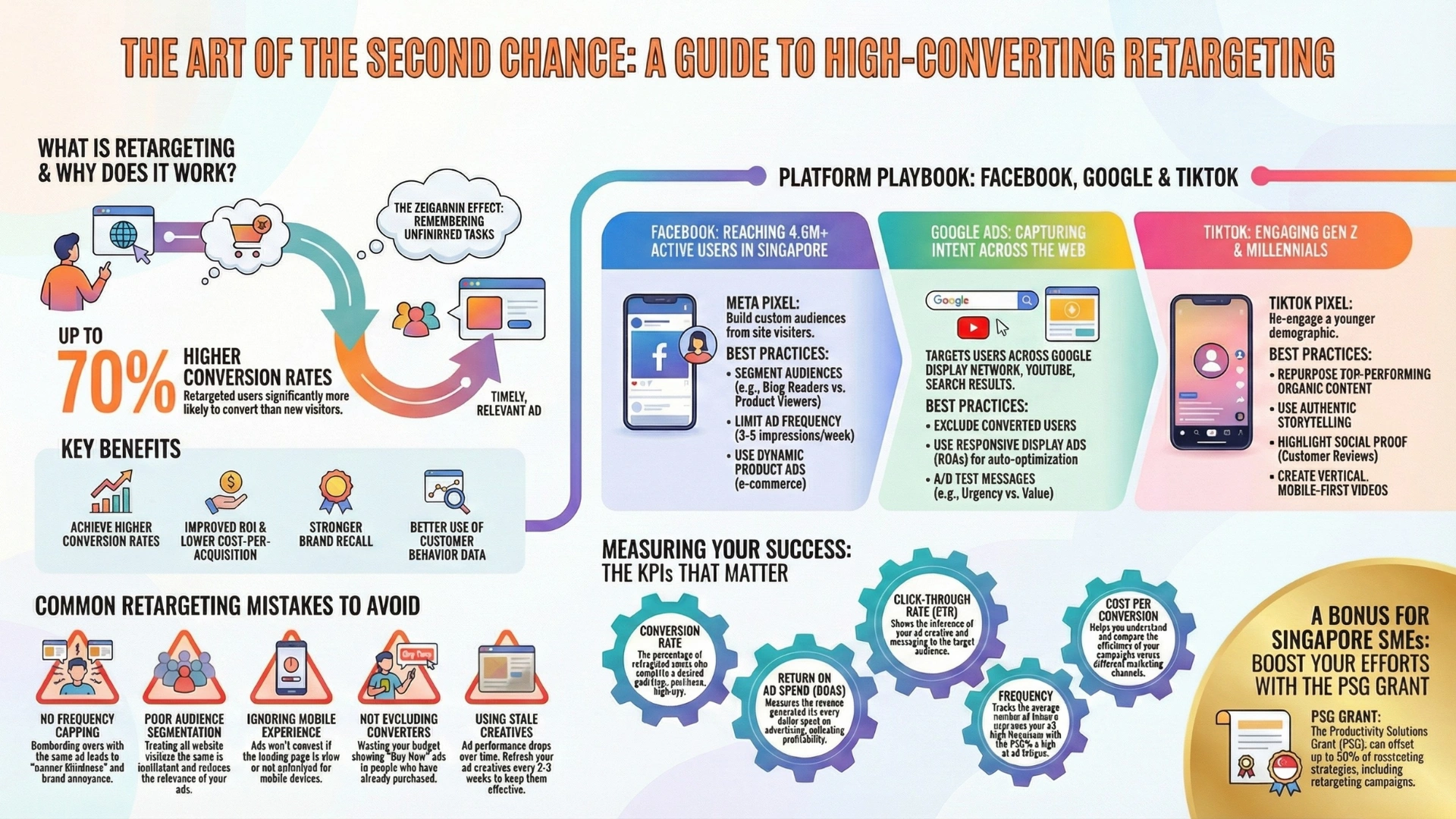
Social Media Retargeting (or remarketing) isn’t about chasing users; it’s about offering closure. It is a digital advertising technique that shows ads to users who’ve previously interacted with your brand. By reappearing with a timely, relevant message across the platforms they already use.
Unlike broad marketing tactics that cast a wide net, retargeting personalises your message to a warm audience already familiar with your brand. This makes it one of the most effective digital marketing methods for driving action.
Key Benefits of Retargeting:
In Singapore’s fast-paced market, where consumers research extensively before purchasing, retargeting bridges the gap between awareness and decision-making, making it essential to any digital success strategy.
- Higher conversion rates: Retargeted users are up to 70% more likely to convert than new visitors.
- Improved ROI: Lower cost per acquisition (CPA) compared to cold traffic campaigns.
- Stronger brand recall: Keeps your brand top-of-mind across digital channels.
- Better use of customer data: Enables you to tailor your marketing to actual user behaviour.
How Does Facebook Retargeting Work and What Should You Use It For?
For Singapore marketers, Facebook remains a high-impact platform due to its 4.6 million+ active users and advanced targeting options based on customer data.
Facebook retargeting uses the Meta Pixel (a tracking code on your site) to build custom audiences from your existing digital interactions. These audiences can then be targeted with highly relevant social media ads.
Best Practices for Facebook Retargeting Ads:
- Segment your audiences: Don’t treat all visitors the same. Separate blog readers from product page viewers.
- Limit ad frequency: Avoid ad fatigue by capping impressions (3–5 per week is ideal).
- Use dynamic product ads: Automatically show products users viewed, especially effective for e-commerce.
- Optimise landing pages: Ensure continuity between ad message and landing page user experience.
How Can You Run Effective Retargeting Campaigns on Google Ads?
Google Ads retargeting (via Google Tag or Google Analytics 4) targets users across the Google Display Network, YouTube, and search engine results, making it ideal for reaching users at different stages of the funnel.
Optimisation Techniques:
- Exclude converters: Stop showing ads to users who have already purchased.
- Use Responsive Display Ads (RDAs): Let Google optimise combinations of headlines, images, and descriptions.
- A/B test messaging: Try urgency (“Offer ends soon!”) vs. value (“See why 1,000+ Singapore customers trust us”).
- Align with SEO: Retargeting complements search engine optimisation by capturing users who searched but didn’t click your organic result.
When combined with paid search campaigns, Google Ads remarketing creates a full-funnel approach, crucial for B2B and service-based businesses in Singapore.
How Does TikTok Retargeting Work and When Should Brands Use It?
TikTok retargeting uses the TikTok Pixel to re-engage users who’ve interacted with your content or website. While newer than Facebook or Google, it’s fast-growing, especially among Gen Z and millennial audiences in Singapore.
Creative Strategies That Work:
- Repurpose top-performing organic content: If a social media post went viral, turn it into a retargeting ad.
- Use authentic storytelling: Avoid overly salesy scripts; focus on relatable moments.
- Highlight social proof: Feature customer reviews or UGC (user-generated content) to build trust.
- Test vertical video: Full-screen, mobile-first creatives perform best.
TikTok retargeting shines for lifestyle, fashion, F&B, and edtech brands in Singapore seeking to build brand awareness and nurture customer relationships among younger demographics.
What Metrics Should You Track to Measure Retargeting Success?
Retargeting success isn’t just about clicks; it’s about meaningful progress toward marketing goals. Use analytics tools like Google Analytics, Meta Ads Manager, or TikTok Pixel to monitor:
Key Performance Indicators (KPIs):
- Conversion rate: Percentage of retargeted users who complete a goal (purchase, sign-up, etc.).
- Return on ad spend (ROAS): Revenue generated per dollar spent.
- Click-through rate (CTR): Indicates ad relevance and creative strength.
- Frequency: Average number of times a user sees your ad, high frequency with low CTR signals fatigue.
- Cost per conversion: Helps compare efficiency across marketing channels.
Also assess audience quality: Are your retargeted users high-intent? If conversion rates are low, refine your audience triggers (e.g., target 2-page visitors instead of 1-page bouncers).
How Can You Integrate Retargeting Into a Full Digital Marketing Strategy?
Retargeting shouldn’t exist in a silo. It’s most powerful when layered into a holistic digital marketing campaign that includes:
- SEO and content marketing to attract organic traffic.
- Email marketing to nurture leads post-conversion (e.g., post-purchase sequences).
- Social media marketing to build community and feed retargeting audiences.
- Automation to trigger timely messages (e.g., abandoned cart emails + retargeting ads).
For example, a Singapore travel agency might use blog content (SEO) to attract users searching “best family resorts in Bali,” retarget those readers with Google Display ads, then follow up via email marketing to deliver an exclusive discount, creating a seamless customer experience across digital channels.
This integrated approach ensures your marketing efforts are cohesive, data-driven, and aligned with business goals.
Common Mistakes to Avoid When Running Retargeting Campaigns
Even experienced marketers stumble. Here’s what to watch out for across social platforms:
- No frequency capping: Bombarding users with the same ad leads to banner blindness, or worse, brand annoyance.
- Poor audience segmentation: Treating all site visitors the same wastes budget and reduces relevance.
- Ignoring mobile UX: If your landing page loads slowly or isn’t mobile-optimised, retargeting won’t convert.
- Not excluding converters: Wasting spend showing “Buy Now” ads to existing customers harms customer loyalty.
- Overlooking creative refresh: Stale creatives lose impact. Update every 2–3 weeks.
Conclusion: What’s the Next Step for Brands Using Retargeting?
Retargeting is no longer optional; it’s a proven marketing method that drives better results by reconnecting with potential customers who are already interested in your brand. Whether you’re running campaigns on Facebook, paid ads on Google, or experimenting with TikTok, the key is to optimise based on data, respect user experience, and align with your broader marketing strategy.
For Singapore SMEs, the Productivity Solutions Grant (PSG) can offset up to 50% of the costs of implementing digital marketing strategies, including retargeting setup and campaign management.
If you’re ready to build a data-driven, high-converting retargeting strategy that works across social media platforms, consider partnering with a PSG Pre-Approved Vendor. Aii Develop specialises in end-to-end digital strategies tailored for Singapore businesses, helping you turn visitors into loyal customers and scale sustainably.