Digital marketing decisions today are driven by data. For Singapore businesses investing in online marketing, understanding which metrics matter and why can make the difference between steady growth and wasted budget. This is where digital marketing consultants play a critical role.
Rather than focusing on surface-level numbers, digital marketing consultants track, interpret, and act on performance data across channels. Their goal is not just to report results, but to guide strategy, optimise campaigns, and support long-term business growth using measurable insights.
Why Are Digital Marketing Metrics Important for Business Growth?
Digital marketing metrics help businesses understand whether their marketing efforts are contributing to real outcomes. Without clear measurement, it is difficult to assess return on investment, refine strategy, or justify budget allocation.
Digital marketing consultants use data to connect marketing performance directly to business goals. Metrics allow them to evaluate which channels are driving value, which campaigns need optimisation, and how customer behaviour is changing over time. In Singapore’s competitive digital environment, this data-driven approach supports smarter decision-making and more sustainable growth.
What Key Data Metrics Do Digital Marketing Consultants Track?
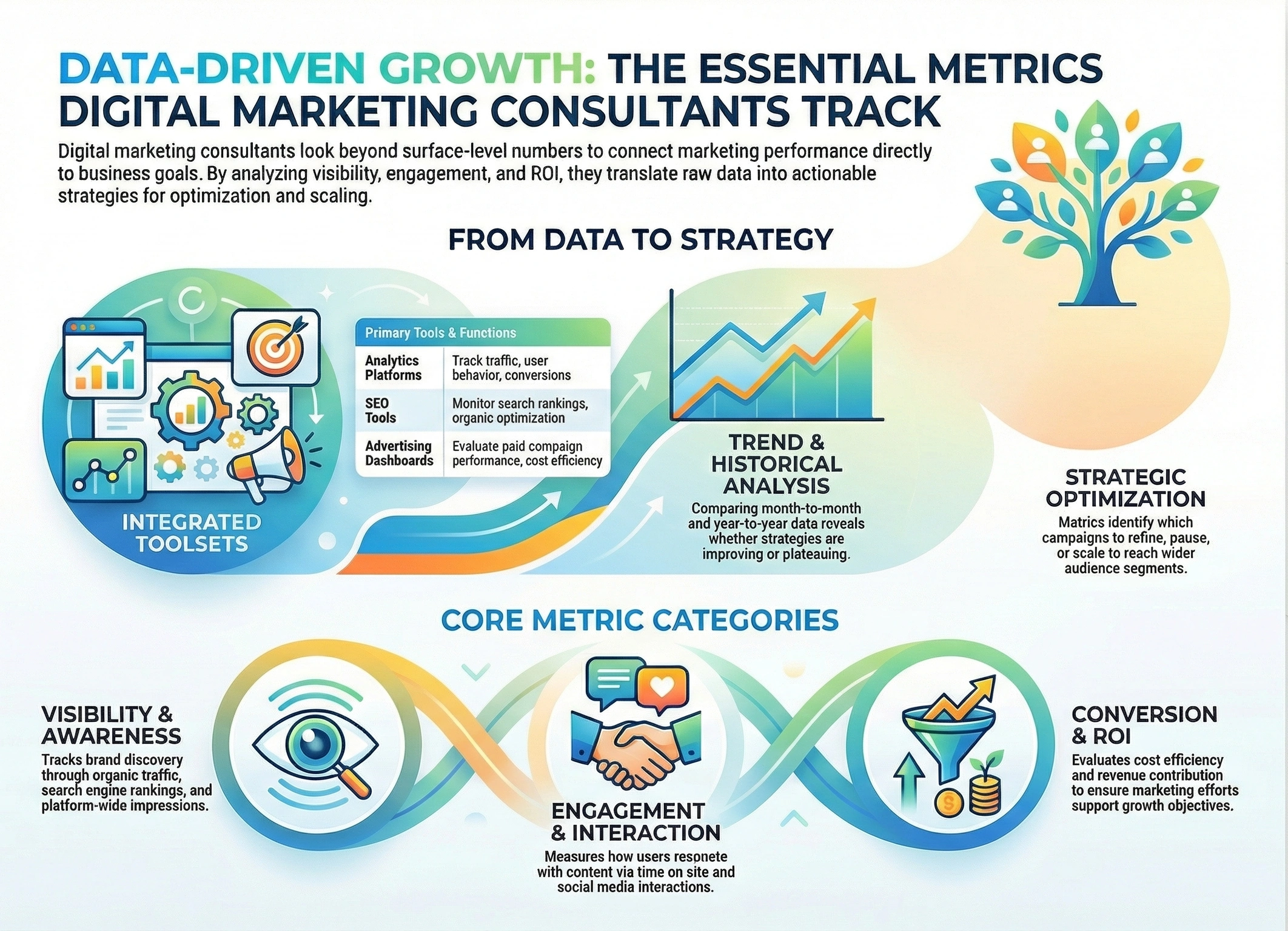
Digital marketing consultants track different metrics depending on the strategy, marketing channels, and business objectives involved. However, several core categories consistently guide performance evaluation.
Visibility And Awareness Metrics
Indicate how well a brand is being discovered online. These include organic traffic, search engine rankings, impressions, and brand awareness indicators across digital platforms.
Engagement Metrics
Reveal how users interact with content and campaigns. Common measures include time on site, pages per session, social media engagement, and content interaction. These metrics help consultants understand whether messaging resonates with the target audience.
Conversion Metrics
This is for evaluating effectiveness. Conversion rate, cost per conversion, lead quality, and campaign performance show whether marketing efforts are translating into meaningful actions.
Return On Investment Metrics
Connect performance to business impact. Digital marketing consultants analyse cost efficiency, revenue contribution, and overall return on investment to assess whether marketing strategies support growth objectives.
What Tools Help Track and Analyse Digital Marketing Metrics?
Digital marketing consultants rely on a combination of analytics and marketing tools to track performance accurately. These tools allow consultants to monitor campaigns, extract insights, and report results clearly to stakeholders.
Commonly used tools include:
- Google Analytics platforms to track traffic, user behaviour, and conversions
- SEO tools to monitor rankings, organic traffic, and optimisation opportunities
- Advertising dashboards to evaluate digital advertising and paid campaign performance
- Social media management tools to measure engagement and platform-specific metrics
By integrating data from multiple tools, consultants build a comprehensive view of digital marketing performance across channels.
How Do Digital Marketing Consultants Analyse Trends and Extract Insights?
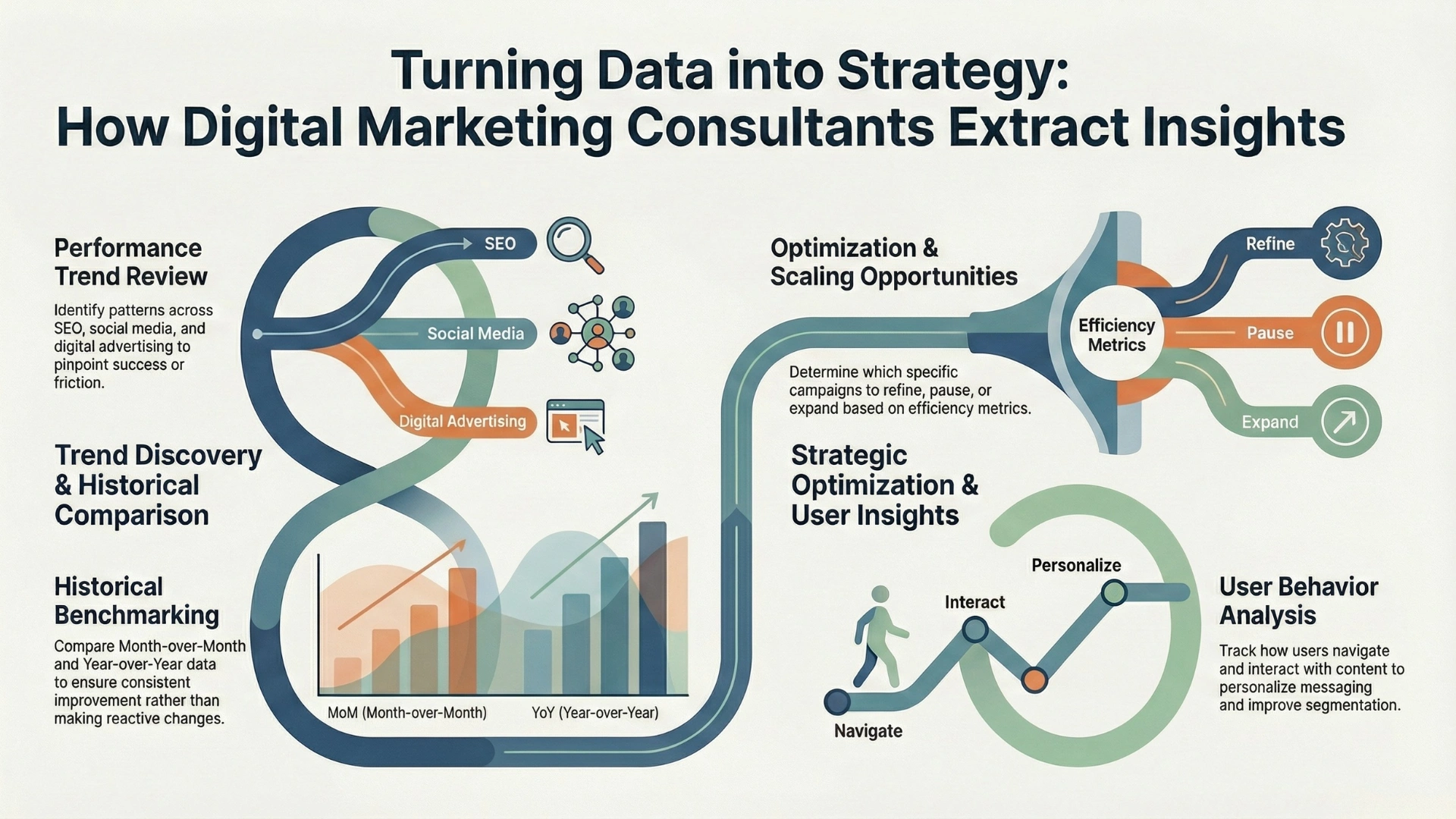
Tracking metrics alone is not enough. The real value comes from analysis and interpretation. Digital marketing consultants focus on identifying patterns, changes, and opportunities within the data.
They begin by reviewing performance trends across marketing campaigns and channels. Increases or drops in key metrics help consultants understand what is driving success or causing friction. This includes analysing campaign performance across SEO, social media marketing, content marketing, and digital advertising.
Historical comparisons play an important role. Month-to-month and year-to-year data reveal whether the digital marketing strategies are delivering consistent improvement or plateauing. These comparisons support informed adjustments rather than reactive changes.
Consultants also use data to identify optimisation and scaling opportunities. Metrics highlight which campaigns should be refined, paused, or expanded to improve marketing success and efficiency.
Finally, user behaviour analysis helps refine targeting and messaging. Understanding how users navigate websites, interact with content, and convert allows digital marketing consultants to improve audience segmentation and personalise marketing initiatives.
How Do Metrics Support Strategic Optimisation and Scaling?
Digital marketing consultants use metrics to move beyond maintenance and into growth. Performance data supports continuous optimisation by revealing where improvements will have the greatest impact.
Optimisation often involves refining messaging, adjusting targeting, improving conversion paths, or reallocating budget across marketing channels. Once performance stabilises, high-performing campaigns can be scaled to reach wider audiences or new segments.
This process ensures marketing efforts remain proactive, responsive, and aligned with evolving business needs rather than static or reactive.
Conclusion: How Will Digital Marketing Metrics Evolve in the Future?
As digital transformation accelerates, digital marketing metrics will become more integrated, predictive, and outcome-focused. Businesses in Singapore can expect greater emphasis on actionable insights, cross-channel attribution, and performance measurement tied directly to business goals.
Digital marketing consultants will continue to play a key role in helping businesses navigate this complexity. By combining analytics expertise with strategic thinking, they help organisations translate data into clarity, optimisation, and measurable growth.
At Aii Develop, digital marketing consultants work closely with businesses to build data-driven strategies that support long-term success. If your business is looking to improve marketing performance through clearer measurement and smarter optimisation, partnering with an experienced consultant can make all the difference.