Is the PSG Digital Marketing Grant Just “Free Money”?
Many SMEs in Singapore tend to view the PSG digital marketing grant as a “subsidy” to offset marketing costs. While the solution grant does provide up to 50% support for qualifying costs, its real value lies in how it is used strategically.
The Productivity Solutions Grant is designed to help businesses adopt pre-approved digital solutions that aim to help productivity and drive measurable growth.
In 2026, this becomes even more important. Rising operational costs, increased competition, and shifting consumer behaviour mean that businesses can no longer rely on basic digital presence alone. Instead, success depends on how effectively digital marketing strategies convert attention into revenue.
A well-structured PSG solution provides insight and allows businesses to reduce inefficiencies, drive marketing performance and outcomes, and optimise for long-term growth and digital capabilities.
Are Businesses Adopting Digital Marketing Services in 2026?
Over the past few years, businesses in Singapore have become more focused on using digital marketing to support real business outcomes. Previously, the priority was often to build an online presence through websites or social media pages. Today, more businesses are looking at how digital efforts can support conversion, automation, and stronger overall performance.
Industry Digital Plans (IDPs) also guide businesses towards digital solutions that are more closely tied to productivity, efficiency, and business growth. This can include combining channels like SEO, SEM, and social media as part of a broader digital marketing approach.
How Should F&B Businesses Use the PSG Digital Marketing Grant?
The Challenge: A High-Cost Industry with Ongoing Demand
F&B businesses operate in a fast-paced environment where customer service and food quality are quick to amend and improve. Along with high rental costs, labour shortages, and intense competition, restaurants must consistently attract customers daily.
Unlike other industries, delayed marketing results often have a limited impact. What matters most is the ability to drive immediate footfall and repeat visits.
A Strategic Solution: From Footfall to Digital Loyalty
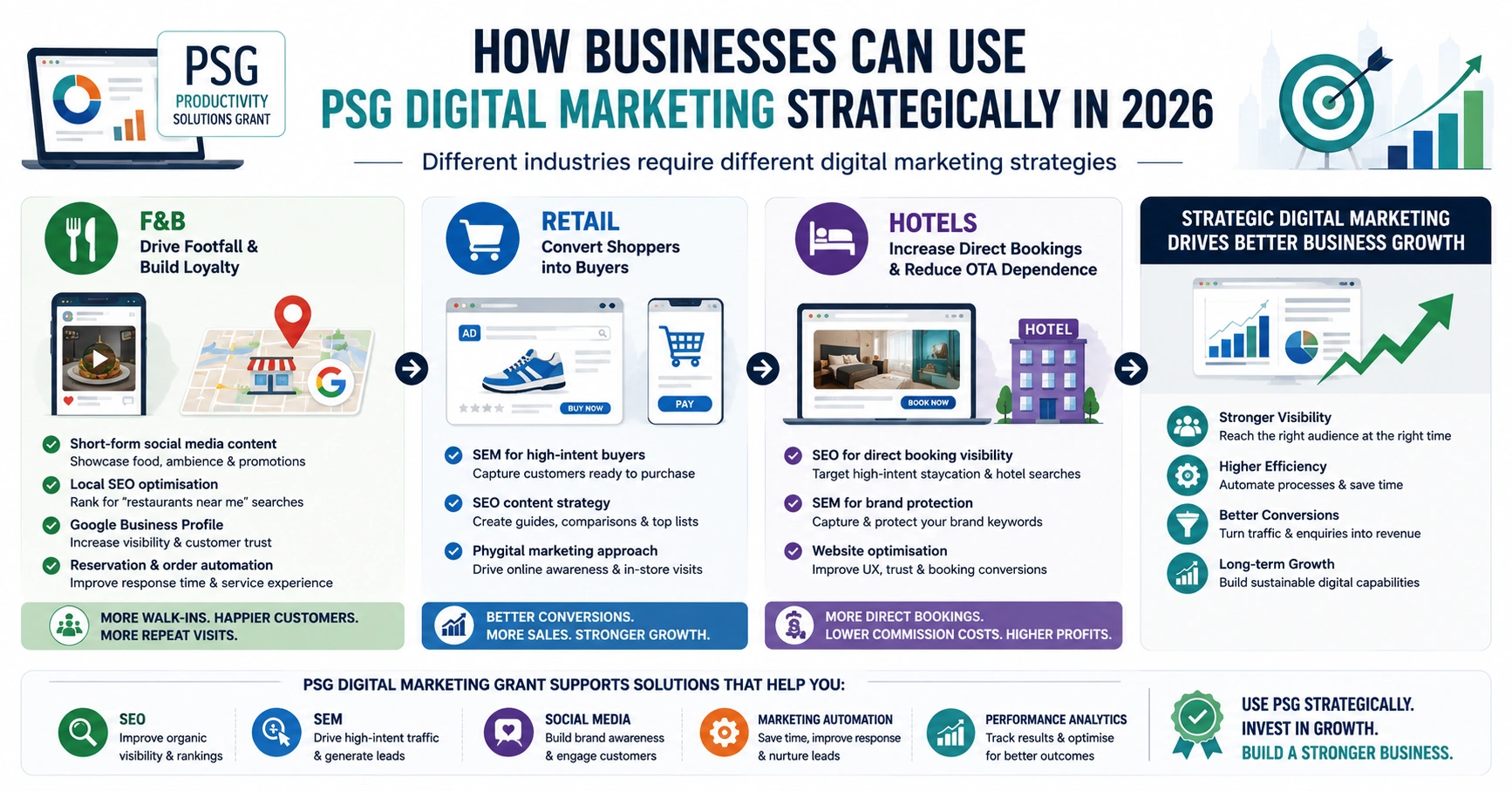
So what is a strategic digital marketing solution for F&B that focuses on capturing attention and converting it into immediate action? Social media marketing can play a key role in this process.
By creating short-form, visually engaging content, businesses can showcase signature dishes and trigger real-time interest. These “visual appetisers” help influence customer decisions within minutes.
At the same time, improving one’s existing local SEO ensures that the business appears when customers search for nearby dining options. Optimising a Google Business Profile allows restaurants to rank for searches such as “best café near me” or “dinner places in [area]”.
The Shift: Automation and Customer Experience in Singapore
In 2026, the focus has expanded towards improving customer experience through automation. F&B businesses can now integrate systems that handle reservations, enquiries, and takeaway orders through different digital channels. This reduces reliance on manual processes while improving response speed and service quality. As a result, businesses can manage higher demand without increasing operational costs.
How Can Retail Businesses Maximise and Apply for the PSG Digital Marketing Grant?
The Challenge: Rising Competition and Acquisition Costs
Retail businesses face growing pressure from e-commerce platforms and social commerce channels. Marketplaces such as Shopee and TikTok Shop have intensified competition, making it more expensive to acquire new customers. In this environment, businesses need to focus on attracting high-intent buyers rather than broad audiences.
The Strategic Solution: From Browsing to Cart Conversion
Search engine marketing (SEM) is essential for capturing customers who are ready to make a purchase. When a user searches for a product with clear intent, such as “buy ergonomic chair Singapore,” a well-optimised ad campaign ensures your business appears at the right moment.
At the same time, SEO supports long-term growth by capturing users during the research phase. Content such as product comparisons, buying guides, and “top 10” lists helps build visibility and trust over time.
The Shift: The Rise of Phygital Retail
Retailers are becoming more connected across online and offline channels. Customers often discover products online before visiting a physical store.
A well-designed digital marketing programme supports both channels. SEO drives organic traffic and awareness, while digital campaigns encourage in-store visits. This integrated approach improves overall sales performance and customer engagement.
How Can Hotels Reduce Their Dependence on OTAs with Digital Marketing?
The Challenge: High Commission Fees
Hotels often rely on Online Travel Agencies (OTAs), which are third-party booking platforms such as Agoda and Booking.com. While these platforms can increase visibility, they also charge commission fees that often range from around 15% to 30% per booking. This can reduce profit margins and limit hotels’ control over customer relationships, data and direct bookings.
The Strategy: From OTAs to Direct Bookings
A Pre-approved digital marketing grant helps hotels shift towards direct bookings. Let’s be honest, most OTA platforms leverage brand keywords to grow their presence. As such, SEO plays a critical role by targeting high-intent keywords such as “staycation Singapore” or “boutique hotel in [location]”. On the other hand, SEM complements this by protecting branded searches. By bidding on their own brand name, hotels can prevent competitors from capturing potential guests on search engines.
The Shift: Building Brand Authority
In 2026, hotels are focusing on strengthening their own digital presence rather than relying solely on third-party platforms. This includes building brand authority, improving website visibility, and enhancing the direct booking experience, growing new and existing segments/businesses. Over time, this reduces dependency on OTAs and improves profit margins.
Why Does Industry-Specific Strategy Matter for the Productivity Solutions Grant?
Not all digital marketing solutions deliver the same outcome and result. Each industry has unique customer behaviour, sales cycles, and operational requirements. A generic approach often leads to inefficient spending and low conversion rates. In contrast, an industry-specific strategy aligns proposed marketing activities with real business objectives and, in turn, drives results.
Furthermore, this ensures that the adoption of PSG digital marketing solutions is used effectively to support both short-term performance and long-term growth.
Conclusion: Is Your PSG Strategy Built for 2026?
The PSG digital marketing grant is more than just financial support. Used well, it can help businesses improve efficiency, strengthen marketing performance, and support long-term growth.
To get the most value from it, businesses need more than a generic package. The strategy should be aligned with the industry, target audience, and business goals.
Aii Develop is a pre-approved vendor, where every project starts with understanding how the business operates and what it needs to achieve. From there, SEO, SEM, and social media are planned as part of a connected strategy, with performance monitored and refined over time.
This gives businesses a clearer path to making better use of the PSG grant while building stronger digital foundations for 2026 and beyond.
If you are unsure which PSG digital marketing package best suits your business, consider a 1-on-1 industry audit to evaluate your current strategy and identify the most suitable next step.