Why Does Voice Search Matter for Businesses in 2026?
Search is no longer limited to typing. More consumers now use voice assistants such as Google Assistant on mobile devices and smart speakers to search for information, compare services, and find nearby businesses.
This shift is changing how companies approach SEO as well. Instead of relying mainly on short typed phrases, users are increasingly speaking in full sentences or questions and using more natural language. These voice queries are often longer, more specific, and closely tied to intent.
For businesses in Singapore, this presents a valuable opportunity. A well-planned voice search optimisation strategy can improve visibility, attract more local traffic, and help businesses appear when potential customers are ready to act.
How Is Voice Search Changing SEO Strategy?
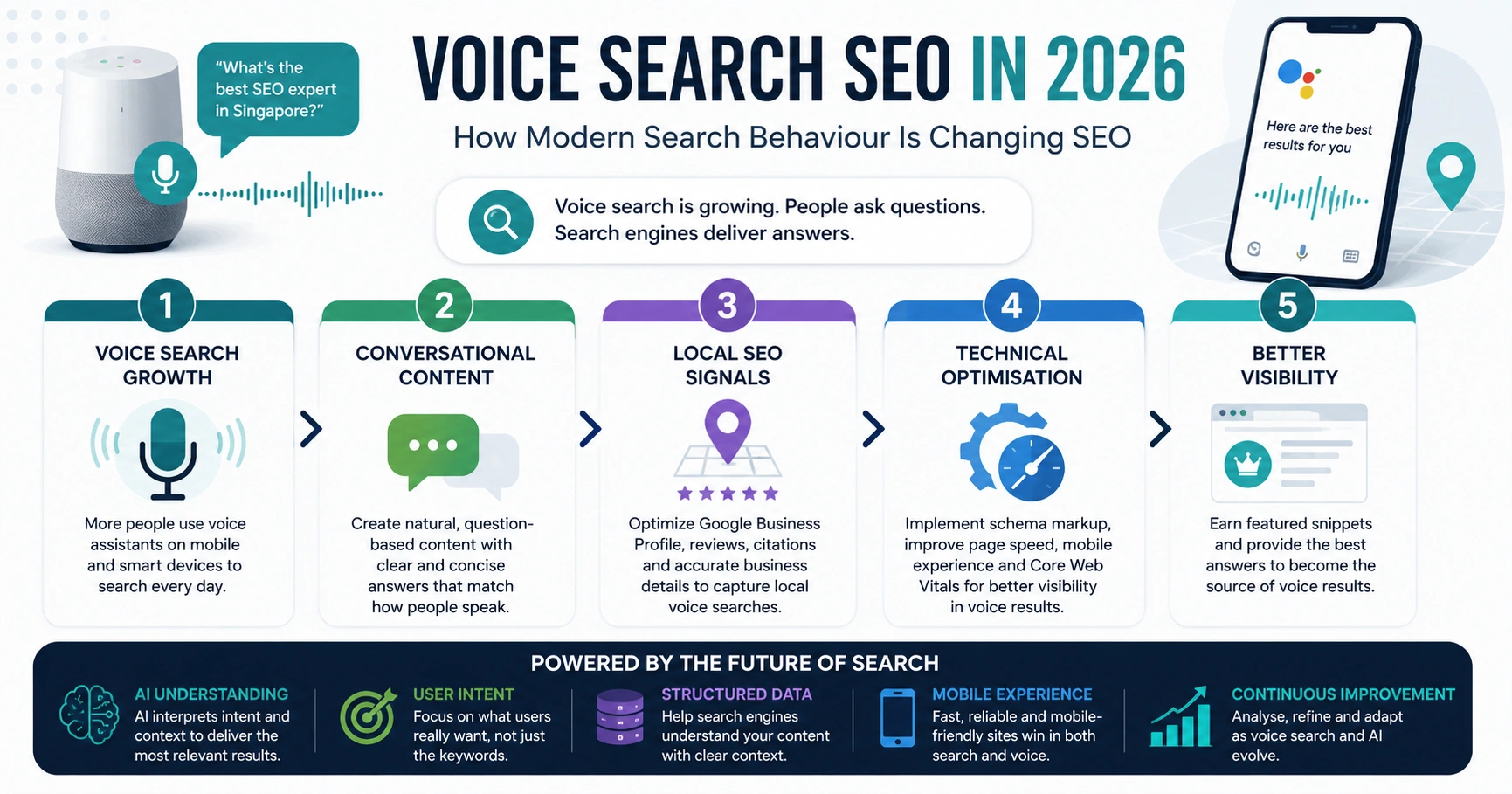
Voice search is changing the way search engines interpret and deliver results. In traditional SEO, users often type short phrases such as SEO agency Singapore. With voice search, they are more likely to ask complete sentences and directed questions in search for answers, such as “Who is the best SEO expert in Singapore for small businesses“?
That difference matters because search engines now place greater emphasis on:
- User intent and context
- Conversational phrasing
- Clear and direct answers
In many cases, voice results are pulled from featured snippets, local listings, or pages supported by strong structured data. This means businesses should not focus only on ranking in the usual search results, but also on becoming the most useful and relevant answer.
How Do Users Ask in Voice Queries?
Most users do not necessarily speak the same way as they type. That is one of the biggest differences between voice and traditional search behaviour.
When people search by voice, they often ask complete questions such as “Where can I find a reliable SEO consultant near me?” or “What is the best way to improve local SEO for a small business?” As most have observed, these searches are more detailed, reflecting how people naturally speak (in their native language).
Because of this, long-tail keywords and question-led phrasing are often more effective than short, broad terms. They usually match intent more accurately and can signal stronger commercial or local interest.
For example, a typed search might be ‘SEO expert Singapore‘, while a spoken/ voice search could be “Which SEO expert in Singapore can help improve website ranking?”. Understanding this difference is essential when shaping a content strategy for voice search.
How Can Content Be Optimised for Voice Search SEO?
To optimise for voice search, content should be clear, direct, and easy to understand. It should also reflect how people actually speak.
A strong approach usually includes a few key elements:
- Conversational content that sounds natural when read aloud
- Clear headings that reflect common search questions
- Concise explanations that answer the query quickly
- Keyword choices that reflect spoken language rather than only typed phrases
This does not mean every paragraph has to be extremely short. It means the content should be easy to follow, logically structured, and clear.
It is also important to think beyond one broad keyword. In voice-led search, users often speak in full queries, so businesses should target phrasing that mirrors real search behaviour. That can include longer, more specific searches that convey stronger intent.
When content provides concise answers and is structured well, search engines are more likely to use it for featured snippets or other spoken responses.
Why Is Local SEO So Important for Voice Search Optimization?
A large percentage of voice searches have local intent. People often use voice to search nearby services, opening hours, directions, or recommendations. Searches such as “find local businesses near me” or “best café open now” are common examples.
It’s important to improve local SEO if a business wants to capture these searches; it needs strong local signals and accurate business details across the web.
A well-maintained Google Business Profile is one of the most important starting points. Details such as the business name, phone number, address, operating hours, and business category should be accurate and consistent. This helps search engines verify the business and improves the chances of appearing in the local pack.
Local listings and customer reviews also matter. They strengthen trust signals and increase the likelihood of appearing in voice search results for nearby services. For many local businesses, voice search is closely tied to how customers discover and compare options in real time.
How Does Technical SEO Support Voice Search?
Strong technical SEO gives search engines the foundation they need to crawl, interpret, and present content properly. Without that support, even well-written pages may struggle to perform.
One key area is schema markup. By using structured data, businesses can give search engines more context about their pages, services, FAQs, and local business details. This can improve eligibility for rich results and make it easier for search engines to understand what the content is about.
Another important factor is page speed. Voice search users typically expect quick answers, especially on mobile devices. Slow-loading pages can weaken both rankings and user experience. Improving Core Web Vitals and reducing friction on mobile pages can support better performance in both traditional and voice-led search.
In simple terms, technical improvements help search engines process content more confidently. That makes them an essential part of any voice search SEO strategy.
How Can Businesses Increase Their Visibility by Appearing in Featured Snippets?
Featured snippets remain highly valuable because they are often used as the source for spoken answers.
To improve the chances of appearing in snippets, content should:
- Answer a clear question directly
- Place the answer near the relevant heading
- Use simple, direct language
- Follow a logical structure that is easy to extract
A strong opening sentence is often more effective than a long introduction before the main point. Search engines tend to favour content that gets to the answer quickly and clearly.
The goal is not only to rank on the SERP, but to create content that search engines can confidently select as the best answer.
What Role Does AI Play in Voice Search Ranking?
AI plays a central role in how voice search works. Search engines use it to interpret meaning, understand context, and return more relevant results.
This means SEO is moving further away from exact-match thinking. Success depends less on repeating the same phrase and more on creating content that reflects intent, clarity, and relevance.
In 2026, SEO requires businesses to think beyond old keyword habits. The stronger approach is to create content that is useful, well-structured, technically sound, and aligned with how people actually search.
Why Work With an SEO Expert in Singapore?
Winning in voice search requires more than adding a few conversational phrases to a page. It involves technical improvements, local optimisation, content refinement, and a strategy that reflects how search behaviour is evolving.
Many businesses struggle with areas such as:
- Choosing the right long-tail search terms
- Implementing the schema correctly
- Strengthening local relevance
- Aligning SEO work with wider business goals
This is where working with an experienced SEO Expert Singapore businesses can trust becomes valuable. A strong SEO strategy should include a technical audit, content improvements, local SEO alignment, and ongoing refinement based on performance data.
Aii Develop supports brands with practical, data-informed SEO strategies designed to improve search visibility, strengthen local presence, and prepare websites for the future of search.