Search engine marketing is one of the fastest ways for businesses in Singapore to gain visibility in competitive search results. As search platforms continue to influence how people discover products and services, many companies choose to work with a specialist partner to manage paid advertising in a structured and cost-effective way, especially after understanding the benefits of SEM services for growing businesses.
What Does a Search Engine Marketing Agency Do?
An SEM agency manages paid search advertising on platforms where users actively look for products or services. Unlike SEO, which builds organic visibility over time, SEM focuses on driving traffic and enquiries more quickly through paid placements.
The agency handles planning, campaign setup, budget management, performance monitoring, and ongoing optimisation. In Singapore’s competitive digital landscape, this also includes adapting campaigns to local search behaviour and cost dynamics, ensuring spend supports measurable business outcomes rather than just exposure.
Platforms Typically Managed
SEM services usually focus on platforms where search intent is clear and measurable. These commonly include:
- Search ads on major search engines appear when users actively search for relevant terms.
- Microsoft Advertising, which reaches users across Bing, Yahoo, and partner networks
- Display and video placements, often used for remarketing or brand reinforcement alongside search efforts
- Ad extensions, such as call or location details, to improve relevance and engagement
Platform selection depends on business goals, audience behaviour, and available budget. A good agency prioritises channels that reach high-intent users rather than spreading spend too thinly.
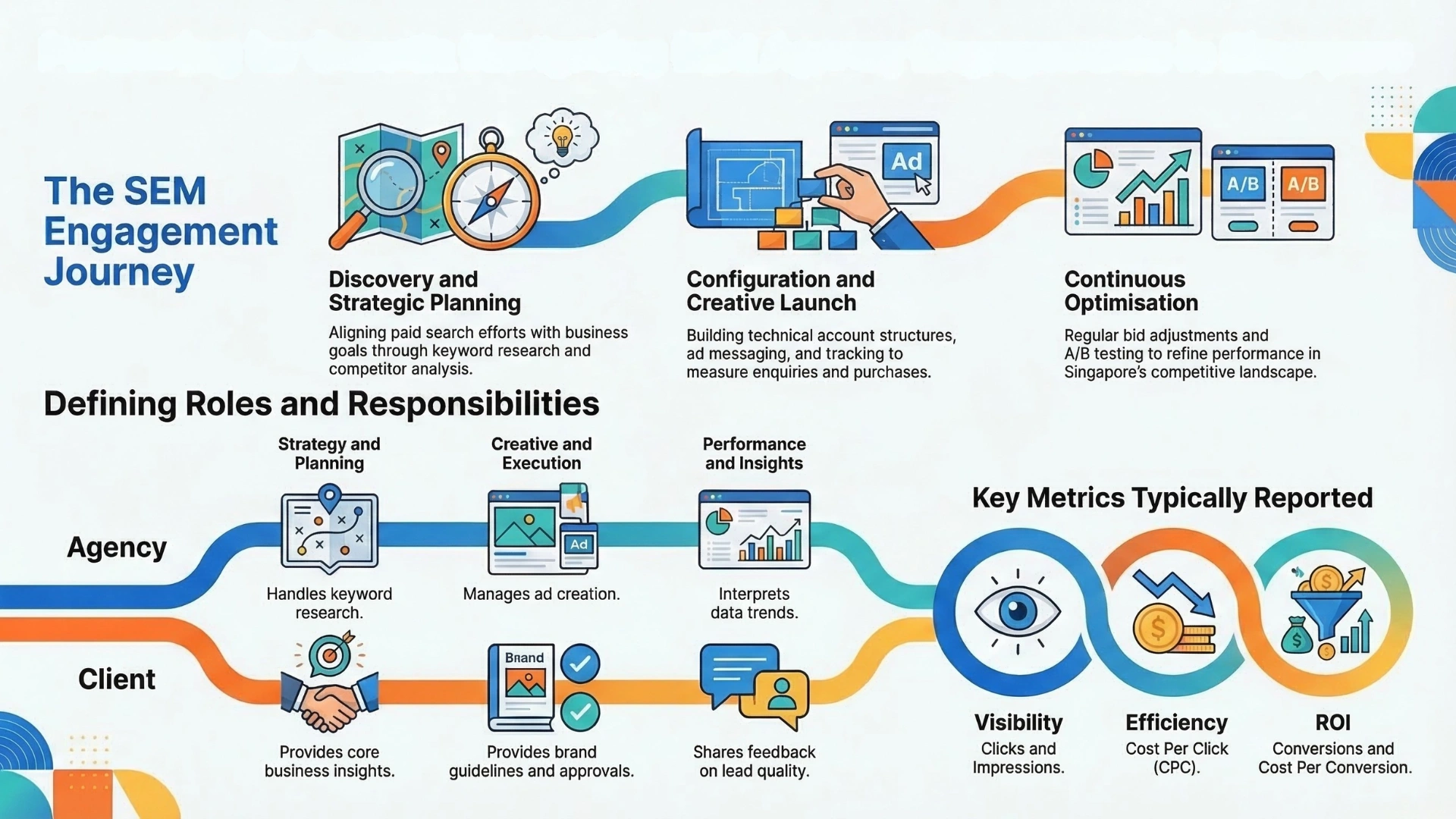
How Does the SEM Agency Engagement Process Work?
Initial Consultation and Business Discovery
The engagement typically begins with a discovery session. The agency reviews your products or services, target audience, current marketing activity, and existing digital presence. This step ensures paid search efforts support broader marketing goals and that expectations around performance and timelines are aligned.
Research forms the foundation of effective SEM. Specialists analyse search behaviour, competition levels, and user intent to identify terms that can attract qualified traffic. The goal is to focus spending on searches that are relevant and commercially meaningful, rather than chasing volume alone.
Strategy Development and Media Planning
Using research insights, the agency develops a structured plan outlining campaign setup, targeting approach, and budget allocation. This stage defines how spend is distributed across high-intent searches and supporting activity, based on expected return rather than assumptions.
Account and Campaign Configuration
This phase covers account structure, campaign setup, bidding logic, and budget controls. The objective is to ensure ads appear when users are actively searching, without unnecessary overlap or wasted spend.
Ad Copy and Creative Development
Ad messaging plays a major role in performance. Agencies focus on writing clear, relevant copy that encourages clicks while remaining compliant with platform guidelines. Well-written ads set expectations and help filter traffic before users reach your website.
Conversion Tracking and Analytics
Tracking is configured to measure actions that matter to the business, such as enquiries, purchases, or form submissions. This allows performance to be evaluated based on outcomes rather than just clicks or impressions. Many businesses refine their approach by learning to optimise SEM campaigns based on real conversion data.
Ongoing Review and Adjustments
Campaigns are monitored regularly to adjust bids, refine keyword targeting, manage costs, and improve efficiency. Irrelevant searches are filtered out to keep spend focused on meaningful intent.
Testing and Improvement
Agencies test variations in messaging, targeting, and landing page elements to improve results over time. This process supports steady performance improvement in a competitive market rather than relying on short-term spikes.
What Metrics Are Typically Reported
Most agencies report on:
- Clicks and impressions
- Cost per click
- Conversions and cost per conversion
- Website traffic generated from paid search
These indicators help businesses understand whether the budget is translated into meaningful activity.
Reporting Frequency and Communication
Monthly reporting and review calls are common. A reliable partner explains results clearly and highlights next steps, rather than presenting data without context.
Roles and Responsibilities: Agency vs Client
What are the roles and responsibilities between an Agency vs Client
Successful SEM campaigns work best as a partnership. While the agency drives strategy and execution, the client provides the business context and assets needed to keep campaigns aligned with real commercial goals.
| Area | What the SEM Agency Handles | What the Client Provides |
|---|---|---|
| Strategy & Planning | Keyword research, campaign structure, bidding strategy, audience targeting | Business goals, target audience insights, product/service priorities |
| Campaign Setup & Execution | Ad creation, platform setup, tracking configuration, and ongoing optimisation | Brand guidelines, approvals, access to accounts or platforms |
| Performance Optimisation | A/B testing, budget allocation, search term refinement, bid adjustments | Feedback on lead quality, sales outcomes, and seasonal priorities |
| Reporting & Insights | Performance reports, analytics interpretation, and strategic recommendations | Internal data context, conversion updates, decision-making input |
| Creative & Landing Pages | Recommendations for ad copy and landing page improvements | Landing page updates, content assets, images, offers |
| Compliance & Platform Updates | Keeping campaigns aligned with platform policies and algorithm changes | Timely approvals and implementation support |
How Can You Tell If an SEM Agency in Singapore is the Right Fit for Your Business?
Key Questions to Ask Before Engaging
Before committing, businesses should ask:
Relevant experience & local expertise: Has the agency worked with similar industries or business models, and do they understand Singapore’s digital landscape, targeting considerations, and market trends?
Strategic approach and customisation: How does the agency handle research, optimisation, and testing, and do they build tailored campaigns instead of relying on one-size-fits-all strategies?
Reporting transparency & communication: Will you receive regular updates, clear performance explanations, and actionable recommendations rather than just basic reports?
Data access and accountability: Will you have visibility into campaign performance, conversion tracking, and the metrics that influence ROI?
Integration with broader marketing efforts: Can paid search align with SEO, content marketing, or other digital channels to support long-term growth?
Focus on real business outcomes: Does the agency prioritise qualified traffic, conversions, and commercial results, not just impressions or clicks?
By addressing these considerations upfront, businesses can move forward with clearer expectations, stronger alignment, and a more effective working relationship with an agency in Singapore.
Choosing the Right SEM Agency Singapore
Working with an SEM agency Singapore requires strategy, transparency, and ongoing optimisation. Aii Develop is the go-to agency for businesses in Singapore, offering expert SEM services, compelling ad campaigns, and measurable results.
We also support SMEs in leveraging the Productivity Solutions Grant (PSG) for digital marketing services in Singapore, helping businesses access top-tier SEM strategies while optimising budgets.
With Aii Develop, businesses can confidently boost online visibility, drive website traffic, and grow their digital presence in today’s landscape.
Frequently Asked Questions About Working with an SEM Agency Singapore
Google Ads is one component of search engine marketing. SEM refers to paid placements across search engines such as Google, Bing, and Yahoo. While Google Ads campaigns are often the primary focus for businesses due to their reach and intent-driven targeting, SEM also includes paid search activity across other networks. In short, Google Ads falls under SEM, but SEM is not limited to Google Ads alone.
Besides Google Ads, businesses can run search advertising on platforms like Bing Ads (Microsoft Advertising) and Yahoo Gemini. These platforms allow paid search campaigns, keyword targeting, and ad copies, helping reach audiences beyond Google search engine results pages.
Results depend on keyword competition, ad quality, landing pages, and marketing budget. Traffic and conversions can begin within a few weeks, but meaningful insights usually take 60–90 days. A SEM agency Singapore continuously optimises campaigns to maximise ROI.
An agency typically provides:
- Keyword research and SEM strategy development
- Google Ads management and paid search campaigns
- Ad copies and landing page optimisation
- Conversion tracking and performance reporting
- Integration with SEO and broader digital marketing strategies
SEM focuses on paid ads for immediate online visibility, while SEO improves organic search results over time. Combining SEO and SEM increases website traffic, boosts online presence, and improves results from both paid and organic channels.