Marketing has always been about reaching the right target audience at the right time. What has changed is how precisely businesses can do this today. Digital marketing strategies outperform traditional methods because they are measurable, data-driven, and designed to adapt in real time.
While traditional marketing relies on broad exposure and delayed feedback, effective digital strategies allow marketers to analyse behaviour, optimise campaigns, and drive results based on actual customer actions. This shift from intuition to insight is what makes modern digital marketing more powerful in 2026 and beyond.
Why Is Data So Important in Modern Digital Marketing?
Data is the foundation of modern digital marketing strategies. It allows businesses to move beyond assumptions and understand how customers behave across multiple touchpoints.
Through analytics and real-time reporting, marketers can see how users interact with content, ads, and websites. This visibility helps teams identify which marketing tactics drive engagement, conversion, and return on investment, rather than relying on surface-level metrics.
Data-driven marketing also enables continuous optimisation. By analysing conversion rates, customer journeys, and demographic patterns, businesses can refine messaging, deploy retargeting campaigns, adjust targeting, and improve performance over time. This makes marketing efforts more measurable, actionable, and aligned with business goals.
How Do Data-Driven Digital Marketing Strategies Compare to Traditional Methods?
Traditional marketing methods, such as print ads, billboards, and radio, rely on broad exposure with limited data feedback. While these channels can support brand awareness, they offer little visibility into customer behaviour, making it difficult to understand which messages, audiences, or placements actually drive results.
Data-driven digital marketing strategies provide far greater clarity. By tracking metrics such as click-through rates, conversion data, and customer interactions across digital channels, marketers can see exactly how campaigns perform and where optimisation is needed. This enables smarter budget allocation and more effective marketing spend based on real performance.
Another critical difference is adaptability. Digital marketing campaigns can be adjusted in real time using live data, while traditional campaigns remain fixed once deployed. This ability to test, optimise, and scale based on insights is why data-driven digital marketing consistently delivers stronger ROI and more measurable growth than traditional approaches.
What Are the Challenges and Limitations of Digital Marketing Today?
Despite its advantages, digital marketing is not without challenges. Understanding these limitations helps businesses set realistic expectations, avoid reactive decision-making, and focus on long-term strategy rather than short-term tactics or trends.
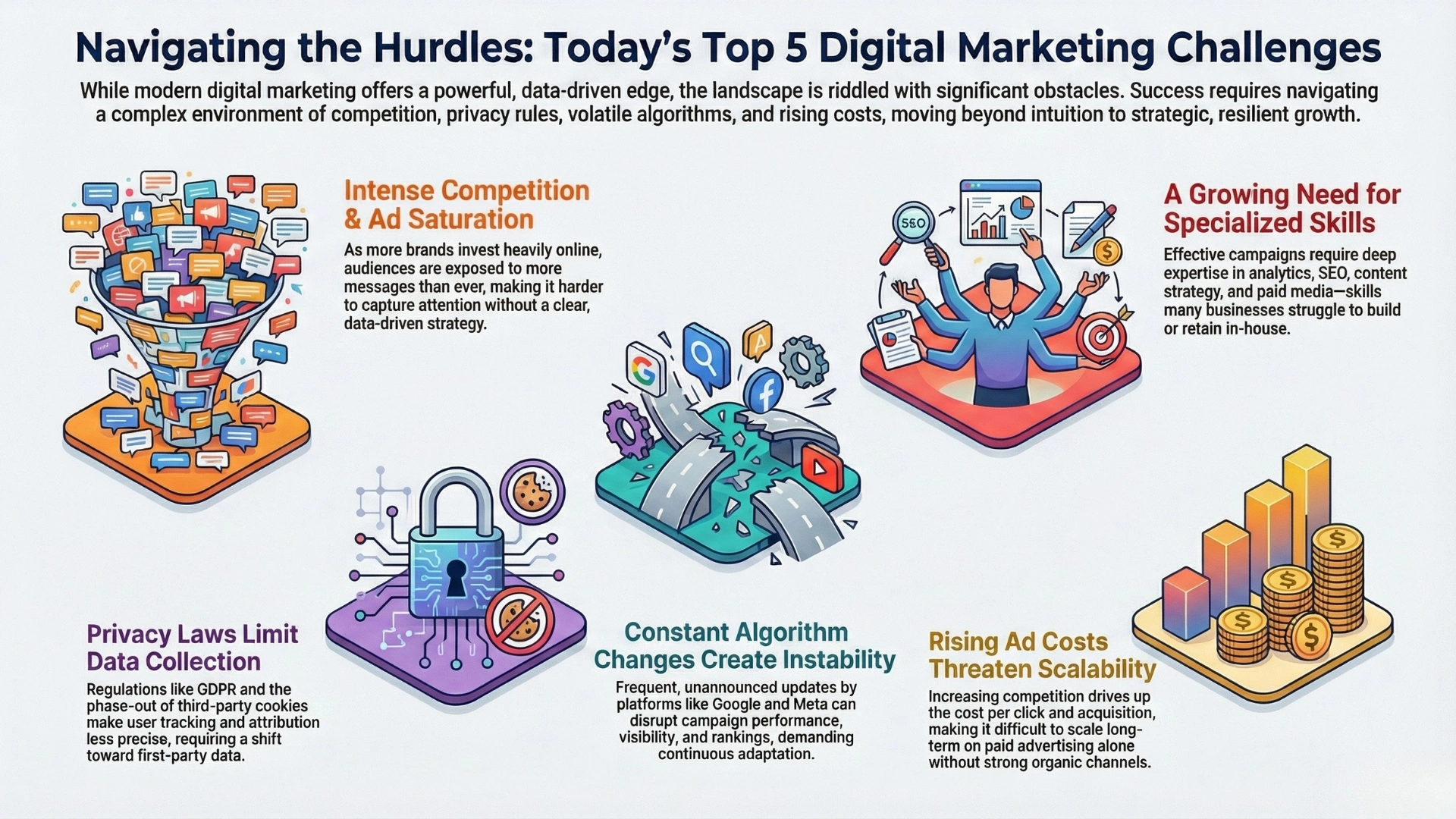
Digital Marketing Faces Growing Competition Across All Platforms
As more brands invest heavily in digital marketing, competition has intensified across search engines, social media platforms, and content channels. Increased ad saturation means audiences are exposed to more messages than ever, making it harder to capture attention. To stay competitive, marketers must differentiate through clearer positioning, stronger value propositions, and data-driven targeting rather than higher spend alone.
Privacy Laws and Tracking Restrictions Limit Data Collection
Privacy regulations such as GDPR, PDPA, and iOS tracking updates have significantly reduced access to third-party data and user-level tracking. As cookies are deprecated and consent requirements tighten, attribution becomes less precise. Businesses must now rely more on first-party data, transparent data practices, and consent-based strategies to maintain trust while still enabling meaningful measurement and optimisation.
Constant Algorithm Changes Affect Campaign Performance
Digital platforms like Google, Meta, and TikTok frequently update their algorithms to improve user experience and combat low-quality content. While these changes benefit users, they can disrupt campaign performance, visibility, and rankings without warning. Marketers must continuously monitor analytics, adapt strategies, and test new approaches to remain resilient against sudden algorithm shifts.
Businesses Need Specialised Skills to Manage Digital Campaigns
Effective digital marketing strategy now requires expertise across analytics, automation, content strategy, SEO, and paid media optimisation. Many businesses struggle to build or retain these specialised skills in-house, leading to fragmented execution. Without the right expertise, campaigns risk being inefficient, under-optimised, or misaligned with broader business goals and customer journeys.
Rising Ad Costs Affect Long-Term Scalability
As competition increases, cost per click and cost per acquisition continue to rise across most digital platforms. Businesses that rely solely on paid advertising may struggle to scale over the long term without a strong focus on optimisation, conversion improvement, and organic channels. Sustainable growth requires balancing paid tactics with content, SEO, and data-driven efficiency rather than increasing budget alone.
How Strategy Helps Navigate Today’s Digital Marketing Challenges
While these challenges make digital marketing more complex, they also reinforce why strategy matters more than ever. Success is no longer about chasing every new platform or tactic, but about using data, insight, and alignment to guide decisions. A well-defined digital marketing strategy helps businesses navigate rising competition, privacy constraints, and algorithm changes by focusing efforts on what drives measurable impact, rather than reacting to short-term fluctuations.
What Does the Future of Digital Marketing Look Like for Singapore SMEs?
For Singapore SMEs, the future of digital marketing will be shaped by smarter use of data, automation, and AI, driven by the need to do more with limited budgets and lean teams. Rather than replacing marketers, AI will help businesses analyse performance faster, personalise messaging at scale, and optimise campaigns more efficiently across key digital marketing channels.
Customer experience will also become a stronger differentiator in Singapore’s competitive market. SMEs that understand the full customer journey and deliver consistent, relevant experiences across search, social, and messaging platforms will be better positioned to compete with larger brands.
At the same time, local businesses will place greater emphasis on first-party data, real-time insights, and integrated strategies that align content, automation, and performance marketing into a single, measurable system, supporting sustainable growth while adapting to privacy and platform changes.
Why Strategy Will Define Digital Marketing Success for Singapore SMEs
For Singapore SMEs, digital marketing represents a strategic advantage, one that rewards clarity, consistency, and intelligent use of data. Businesses that treat digital marketing as a series of disconnected tactics risk being outpaced by competitors who align channels, content, and technology around clear goals.
As data access becomes more restricted, competition intensifies, and platforms continue to evolve, success will depend on how well businesses interpret insights, optimise continuously, and deliver cohesive customer experiences across touchpoints. This is where strategy makes the difference. A data-driven approach allows SMEs to focus investment where it drives real return, rather than spreading the budget thin across trends that fail to convert.
With support such as the PSG Digital Marketing Grant, Singapore SMEs have a practical pathway to adopt structured, future-ready digital strategies without high upfront cost. Those that act early, by building strong foundations in analytics, automation, and customer-centric marketing, will not only adapt to change but also gain a sustainable edge in an increasingly digital economy.