Measuring ROI (return on investment) is one of the most important aspects of any digital marketing strategy. For businesses working with a digital marketing agency, understanding performance is essential to determine whether campaigns are delivering real results, supporting revenue growth, and justifying marketing investment.
A digital marketing agency does more than execute marketing campaigns. It uses data, analytics, and structured evaluation to understand how each marketing effort contributes to visibility, conversions, and long-term business growth.
Why Is ROI Important for Digital Marketing Agencies and Their Clients?
ROI matters because it links marketing activity directly to business outcomes. Without ROI measurement, marketing becomes a cost rather than a strategic investment.
For businesses, ROI helps clarify:
- Whether digital marketing efforts are generating leads or sales
- Which marketing channels contribute to revenue
- How efficiently is the budget being spent
- Whether it makes sense to invest more
For agencies, ROI demonstrates accountability. It shows clients that strategies are data-driven, measurable, and aligned with business goals rather than vanity metrics.
What Key Metrics Do Digital Marketing Agencies Use to Measure ROI?
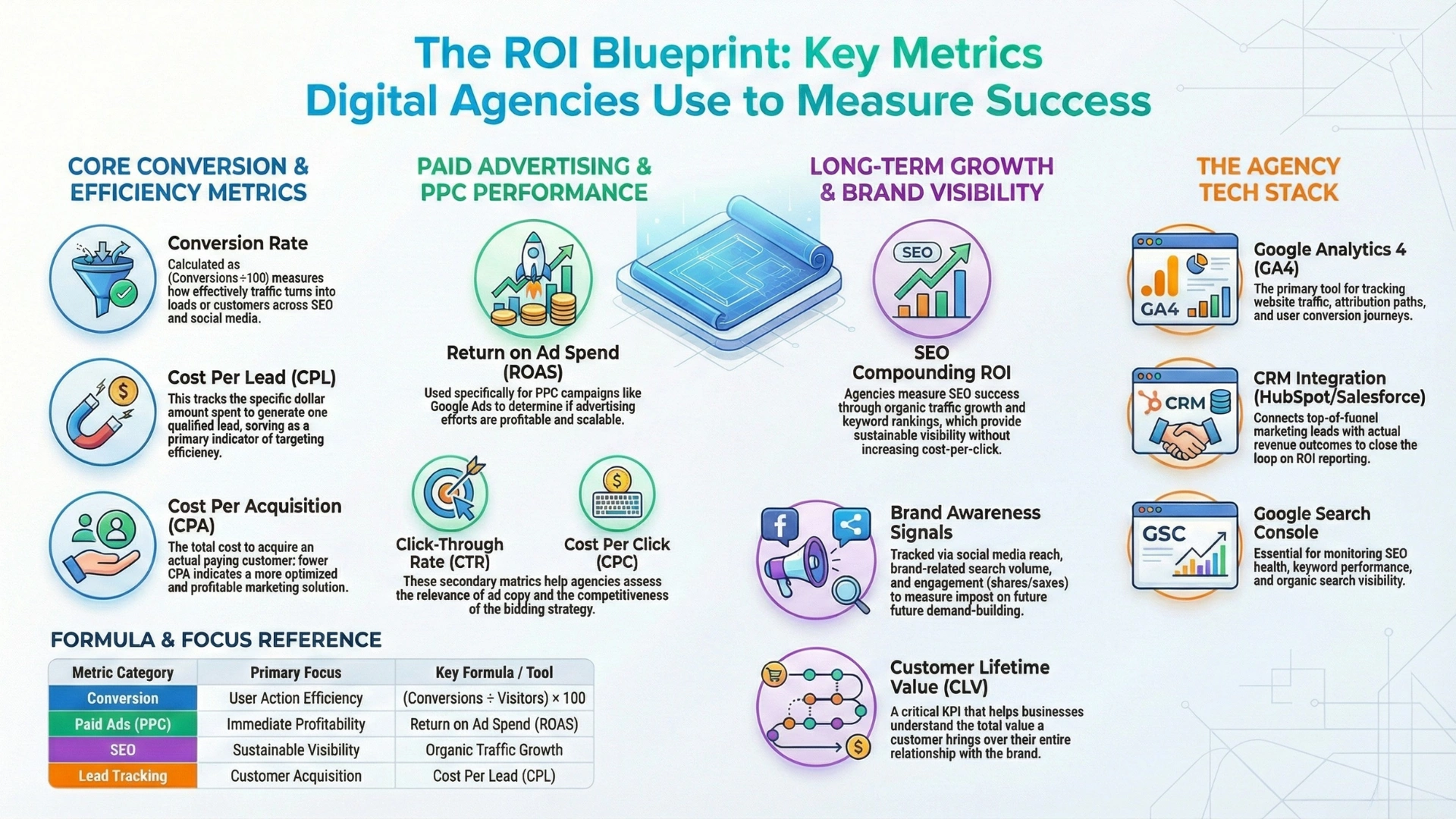
Not all metrics indicate success. Digital marketers focus on metrics that reflect real performance, growth, and profitability.
Conversion rate measures how effectively traffic turns into results
Conversion rate shows how well digital marketing campaigns convert users into leads or customers.
Conversion rate = (Conversions ÷ Total visitors) × 100
This metric helps agencies assess landing pages, messaging, and user experience across SEO, social media marketing, and paid campaigns.
Cost per lead and cost per acquisition reflect efficiency
Cost per lead (CPL) measures how much it costs to generate one qualified lead. Cost per acquisition (CPA) tracks the cost of acquiring an actual customer. Lower CPL and CPA indicate stronger targeting, better optimisation, and more efficient marketing solutions.
Pay-per-click and ROAS evaluate advertising performance
For pay-per-click (PPC) campaigns such as Google Ads, agencies track:
- Click-through rate
- Cost per click
- Return on ad spend (ROAS)
These metrics help determine whether advertising campaigns are profitable and scalable.
Brand Awareness and Visibility Signals Effort to the Right Audiences.
ROI is not always immediate revenue. For businesses focused on long-term growth, brand awareness signals whether marketing efforts are expanding reach and recognition among the right audience.
Agencies typically track:
- Impressions and reach across social media platforms
- Brand-related search volume on search engines
- Engagement signals such as shares and saves
- Growth in direct website traffic
How Does SEO Contribute to Long-Term ROI?
SEO’s ROI is critical to keep track of because it delivers compounding visibility over time.
Agencies measure SEO performance using metrics such as:
- Organic traffic growth
- Keyword rankings on search engines
- Conversion rate from organic visitors
- Cost efficiency compared to paid channels
Unlike short-term advertising, SEO drives ongoing traffic and brand visibility without increasing cost per click, making it a core pillar of growth and measurable success.
What Role Does Marketing Automation Play in ROI Measurement?
Marketing automation improves efficiency and attribution by tracking users across multiple touchpoints. This is especially valuable for businesses of all sizes that manage longer sales cycles.
Automation tools help:
- Track lead journeys from first click to conversion
- Attribute revenue to specific marketing campaigns
- Nurture leads via email marketing
- Reduce manual effort while improving conversion rates
How Do Key Performance Indicators Keep Marketing Aligned With Business Goals?
Key performance indicators (KPIs) ensure marketing activity remains focused on outcomes that matter.
Common KPIs include:
- Lead volume and lead quality
- Conversion rate by channel
- Cost per lead and acquisition
- Customer lifetime value
Choosing the right digital marketing KPIs helps teams focus on metrics that drive business growth rather than those that look good but don’t.
How Do Digital Marketing Agencies Track, Report, and Explain ROI?
Measuring ROI is only useful if it is reported clearly and translated into meaningful business insights. Leading digital marketing agencies focus on transparency, context, and decision-making, not just raw numbers.
Strong reporting helps businesses understand what’s working, why it’s working, and what should change next.

How Agencies Structure ROI Reporting for Clarity
Effective ROI reporting goes beyond dashboards and spreadsheets. Agencies typically present data in a way that aligns performance with business goals.
This usually includes:
- Clear performance summaries tied to objectives
- Metrics explained in business terms, not technical jargon
- Month-on-month or quarter-on-quarter comparisons
- Actionable insights highlighting optimisation opportunities
This approach ensures stakeholders can quickly assess marketing performance without needing deep analytics expertise.
What Tools Do Agencies Use to Track ROI and Key Performance Indicators?
To measure ROI accurately, agencies rely on a combination of analytics, advertising, and CRM tools. Each tool plays a different role in tracking metrics across the customer journey.
Commonly used tools include:
- Google Analytics 4 (GA4) for website traffic, conversions, and attribution paths
- Google Ads and Meta Ads Manager for pay-per-click performance, cost per lead, and ROAS
- Google Search Console for SEO visibility, keyword performance, and organic search health
- CRM platforms such as HubSpot or Salesforce to connect leads with revenue outcomes
These tools allow agencies to track metrics like conversion rate, cost per acquisition, click-through rate, and customer lifetime value across channels.
How Do Agencies Connect Marketing Metrics to Business Outcomes?
Metrics only matter when they relate back to revenue and growth. Agencies use tracking frameworks and attribution models to link marketing activity to results.
This includes:
- Mapping leads from first touch to final conversion
- Comparing performance across digital marketing campaigns
- Identifying which channels drive qualified leads, not just traffic
- Highlighting inefficiencies where the budget can be reallocated
Some agencies also use an ROI calculator to model scenarios and forecast results, helping clients understand potential returns before scaling spend.
How Does ROI Measurement Drive Better Digital Marketing Decisions?
ROI measurement guides smarter marketing decisions by showing which strategies truly deliver results. When agencies track ROI consistently, it can ensure marketing investment remains efficient and results-driven.
This is done by:
- Optimise underperforming campaigns,
- Reallocate budget to high-performing channels, and
- Scale efforts that support business goals.
However, numbers alone do not explain performance. Qualitative insights help reveal why results change. Factors such as brand sentiment, user feedback, engagement patterns, and behaviour flow often explain shifts in conversion rate or lead quality.
By combining quantitative data with qualitative insights, agencies refine messaging, improve user experience, and drive more sustainable long-term ROI.
Why Does ROI Measurement Matter for Small Business Owners?
For small business owners, ROI measurement is less about theory and more about protection. With limited marketing budgets and tighter margins, every marketing decision directly affects cash flow, time, and growth momentum.
Tracking ROI helps small businesses:
- Identify which digital marketing efforts actually generate leads or sales
- Stop investing in channels that look busy but don’t convert
- Prioritise strategies that support sustainable revenue growth
- Scale marketing spend confidently, knowing what works and what doesn’t
Without clear ROI tracking, marketing becomes a guessing game. A right digital marketing agency helps small businesses translate performance data into practical decisions, adjusting campaigns quickly when results fall short and doubling down when strategies deliver measurable impact.
Conclusion: Why ROI Measurement Defines Digital Marketing Success
Measuring ROI ensures digital marketing is accountable, strategic, and results-driven. By tracking the right metrics, analysing performance across channels, and aligning efforts with business goals, a digital marketing agency helps turn marketing investment into measurable impact.
For businesses seeking solutions that drive real results, working with a results-driven partner like Aii Develop provides added clarity and confidence. Through data-led strategies and transparent performance tracking, Aii Develop supports sustainable growth and measurable success across industries, regardless of business size.